Most Denver e-commerce brands are building a list. Almost none of them are building a system. Here is how the systematic approach drives repeat revenue.
Most Denver e-commerce brands are building a list. Almost none of them are building a system.
That distinction is where email marketing in Denver breaks down.
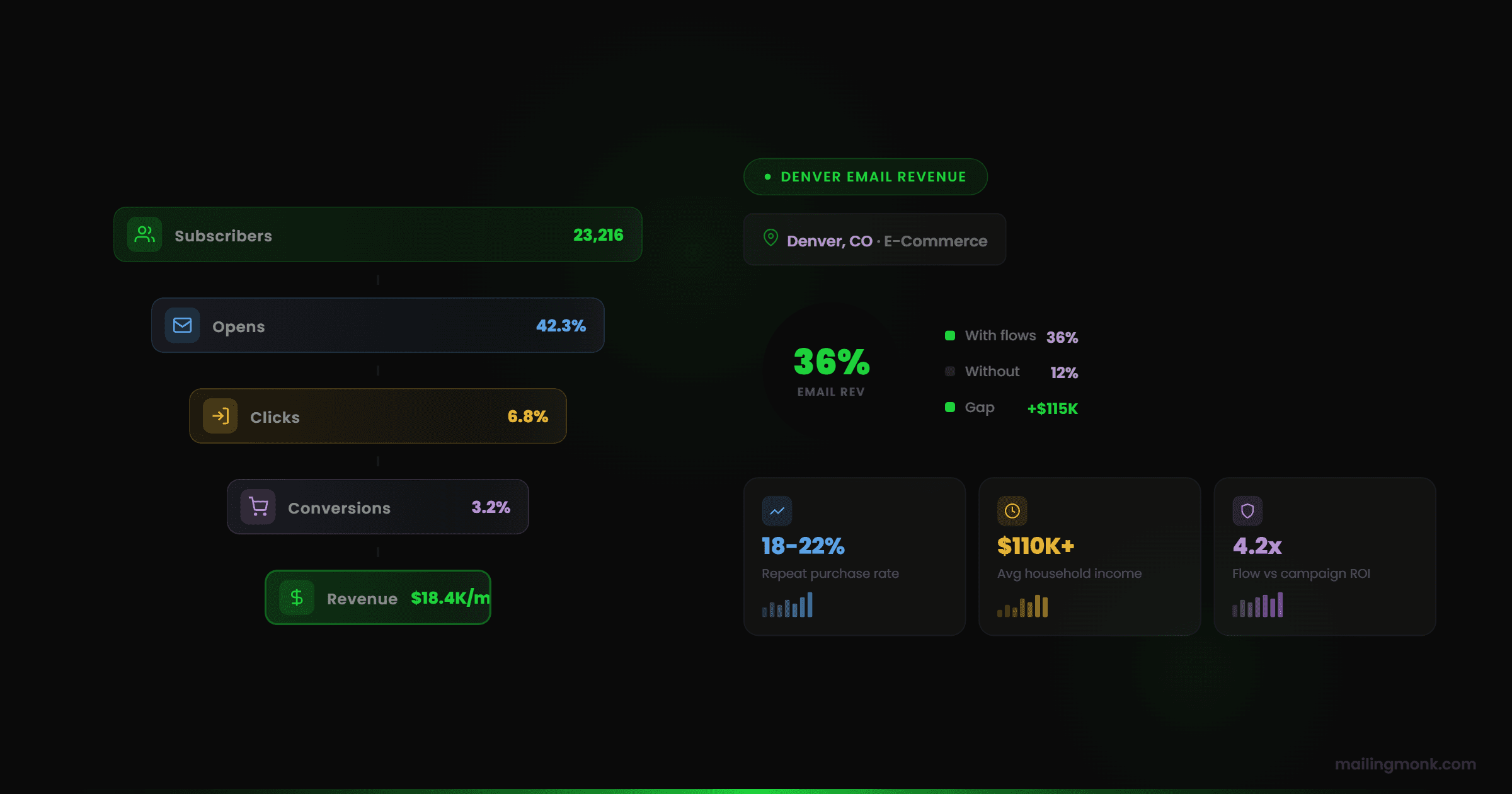
Median household income sits above $110,000, according to US Census Bureau data. The outdoor gear market is real. The DTC scene is growing fast. And most brands with a subscriber list are treating it like a broadcast channel instead of a revenue engine.
Klaviyo's retention benchmarks show that e-commerce brands with strong segmentation programs consistently hit repeat purchase rates of 18 to 22 percent within the optimal re-engagement window. Brands without those programs sit at four to six percent. The list is the same. The approach is not.
Denver's e-commerce market is bigger than most brands realize
Storeleads data puts Colorado at 23,216 active Shopify stores, with Denver as the dominant market. VF Corporation relocated The North Face, Timberland, and Altra here. Outdoor and DTC brands cluster across the metro. Tech companies do too.
That concentration matters for email. These are buyers with genuine purchasing power and strong brand loyalty when brands earn it.
The problem is not the market. It is what most brands do once they have an email subscriber.
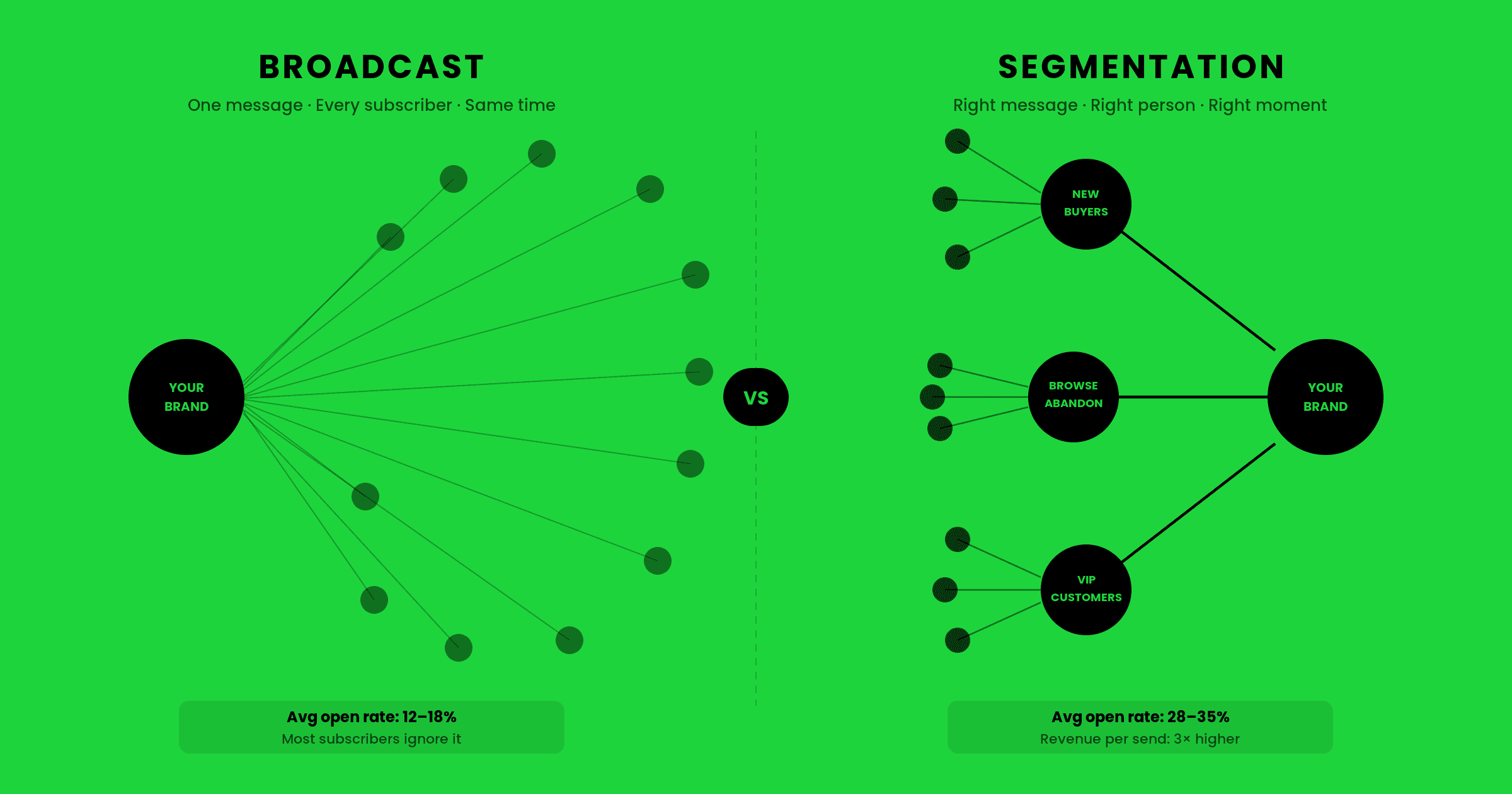
They send everyone the same message on the same day. The October ski gear buyer gets the spring collection email. The first-time visitor who downloaded a sizing guide gets the same loyalty offer as a repeat purchaser. Everyone, every send, the same blast.
That approach works at the start. It stops working somewhere around 5,000 subscribers. After that, the brands that segment, automate, and measure pull ahead. The ones that keep blasting fall behind.
The email marketing mistake most Denver brands keep making
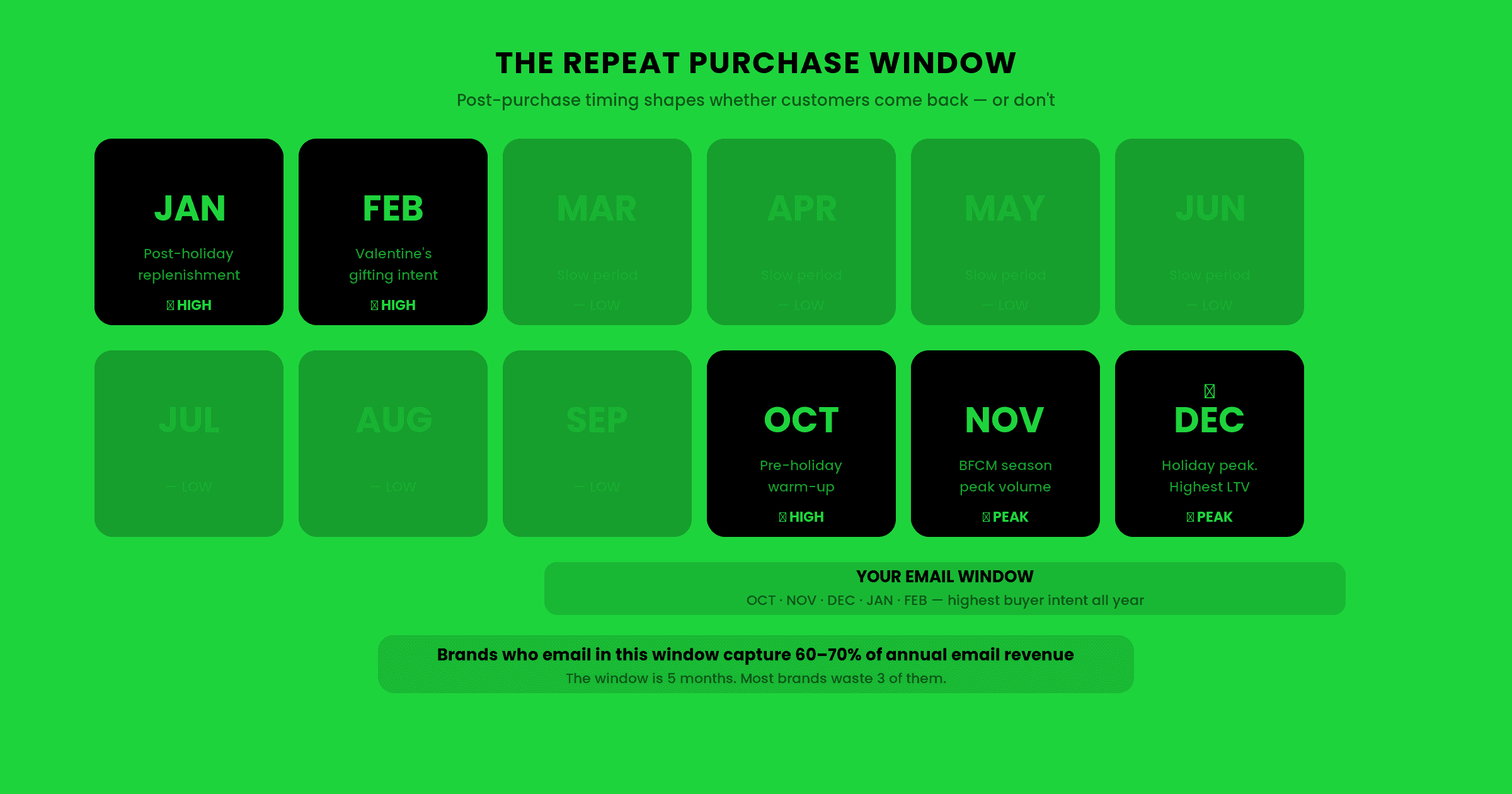
Denver retail is seasonal by nature. Outdoor apparel peaks October through February. Home and garden spikes in spring. Beauty tracks with holidays.
Sending identical emails to everyone across every season is not a strategy. It is noise.
The customer who bought a ski jacket in January is not thinking about spring hiking boots in March. Sending them a spring collection blast trains them to ignore future emails. Over time, that erodes your most valuable asset: their attention.
Segmentation solves this. Not complex segmentation. Simple, behavior-based segmentation.
What did this person buy? When did they buy it? What does that tell you about what they want next?
A Denver apparel brand with 20,000 subscribers does not send one email. It sends three. One to customers who purchased in the last 60 days. One to customers who have not opened anything in 45 days. One to first-season buyers who never came back.
Three messages. One send date. Far better results than a single blast to 20,000 people who are all at different points in their buying cycle.
Abandoned cart emails are the easiest revenue most brands are skipping
Most Denver brands either skip abandoned cart emails entirely or send one generic follow-up 24 hours after abandonment.
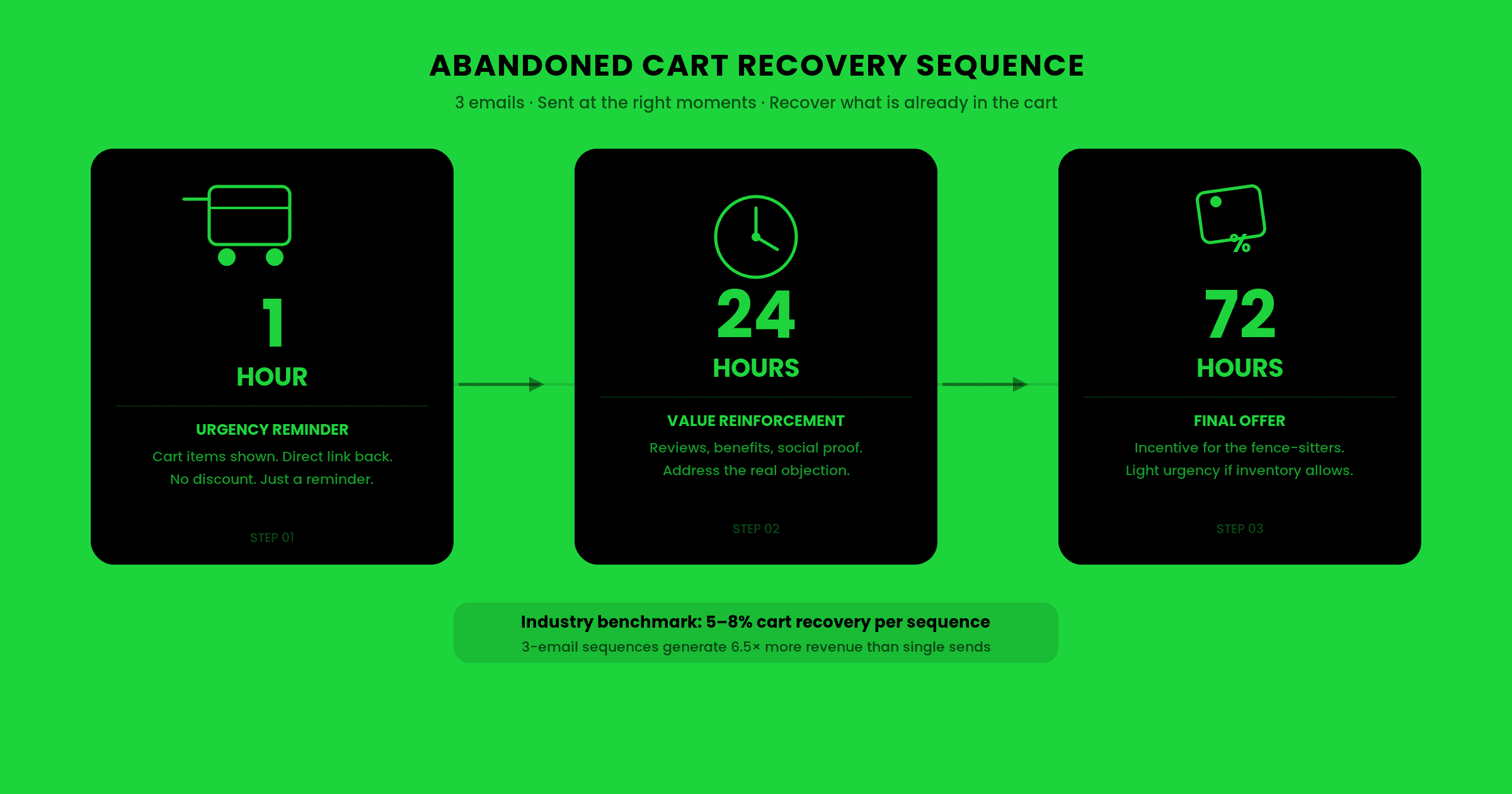
Klaviyo data shows that well-structured abandoned cart sequences recover substantial revenue that would otherwise be gone. The sequence that works is three emails, each one doing a specific job.
Email one goes out within one hour of abandonment. No story, no discount. Just the exact items left in the cart and a direct link back. This catches the people who got distracted or closed the wrong tab by accident.
Email two arrives 24 hours later. This one addresses the real friction. Was it price? Shipping cost? Uncertainty about sizing? Name the actual objection and handle it directly. A 10 percent discount makes sense if price was the genuine barrier. Social proof works too. "This item sold out twice last month" is far more persuasive than a generic coupon code.
Email three runs at 72 hours. Light urgency if there is a real inventory constraint. A simple final nudge if there is not. The rule is non-negotiable: never fabricate scarcity. Customers who have been burned by fake urgency recognize it instantly and stop trusting the brand.
For a store doing $50,000 a month, a properly built three-email sequence typically recovers $3,000 to $8,000 in additional monthly revenue. Zero extra ad spend. Most brands skip this because setup sounds complicated. The actual build takes an afternoon.
The repeat purchase window closes faster than most brands expect
Here is what most brands get wrong about retention: customers are not always available to be re-engaged.
There is a window. It is narrower than most people think.
For an outdoor apparel brand, that window runs roughly four to five months after the first purchase. A customer who bought a fleece jacket in October is most likely to buy again between December and February. By April, the window is closing. By June, it is gone.
Klaviyo retention benchmarks show that well-run programs convert 18 to 22 percent of customers into repeat buyers within that window. Programs without segmented post-purchase sequences convert 4 to 6 percent.
The difference is not the product. It is timing.
A four-email post-purchase sequence, spread across twelve weeks and timed to when customers in that category actually buy again, works. The same emails sent outside that window do not.
Week one is onboarding and relationship building. Care instructions, complementary products, no hard sell. Week four is a category-relevant recommendation timed to purchase patterns. Week eight is a direct repeat-buy incentive. Week twelve is a soft re-engagement or a quiet exit for customers who have not engaged. This cadence maps to how buying behavior actually works, not what is convenient for a monthly content calendar.
Frequency is not about how often you send. It is about who receives it.
Most brands are asking the wrong question about email frequency.
The question is not "how many emails should we send per week?" The question is "which customers should receive which frequency?"
Active buyers who purchased in the last 60 days can handle two to three emails a week without churning. They are in buying mode. They want to hear about new products and relevant updates. High frequency is completely fine when the content matches what that specific person cares about.
Customers who have been browsing without buying? One email per week, maximum. That email should speak directly to the product they looked at and remove the barrier stopping them from purchasing.
Dormant customers with no purchase in 90 days? One email every two weeks. A genuine reason to return, not a discount blast to a list of people who have already moved on.
Litmus research shows that sender reputation damage from over-mailing takes three to six months to recover. The solution is not blanket email reduction. It is sending more email to the people who want it, and less to the people who do not. That targeted approach keeps unsubscribe rates below 0.3 percent on active segments while protecting deliverability across the whole list.
Personalization that feels useful, not invasive
Denver customers are sophisticated buyers. Facebook and Slack both have offices here. Hundreds of startups operate downtown alongside major tech companies. This is not a market that tolerates lazy marketing.
First-name personalization is the floor, not the ceiling.
Real personalization is behavioral. A customer who browsed winter jackets three times without purchasing gets a jacket-focused email, not a general sale announcement. A customer who has bought running shoes twice gets recommendations weighted toward running, not hiking. A customer who buys on a roughly eight-week cycle gets a re-engagement email at week six, not week three when they are not yet in buying mode.
Klaviyo's dynamic content blocks make this practical to set up. One email template. Multiple content variations driven by purchase history, browse behavior, and engagement timing. Two to three hours to configure. The result is an email that feels written for the specific person receiving it, because the logic behind it was.
That is the gap between a customer thinking "why am I getting this" and "this brand actually pays attention."
The one metric that tells you if email is actually working
Most Denver brands optimize for open rates. Open rates are a starting point.
They tell you whether someone clicked to see your email. They tell you nothing about whether anyone bought anything.
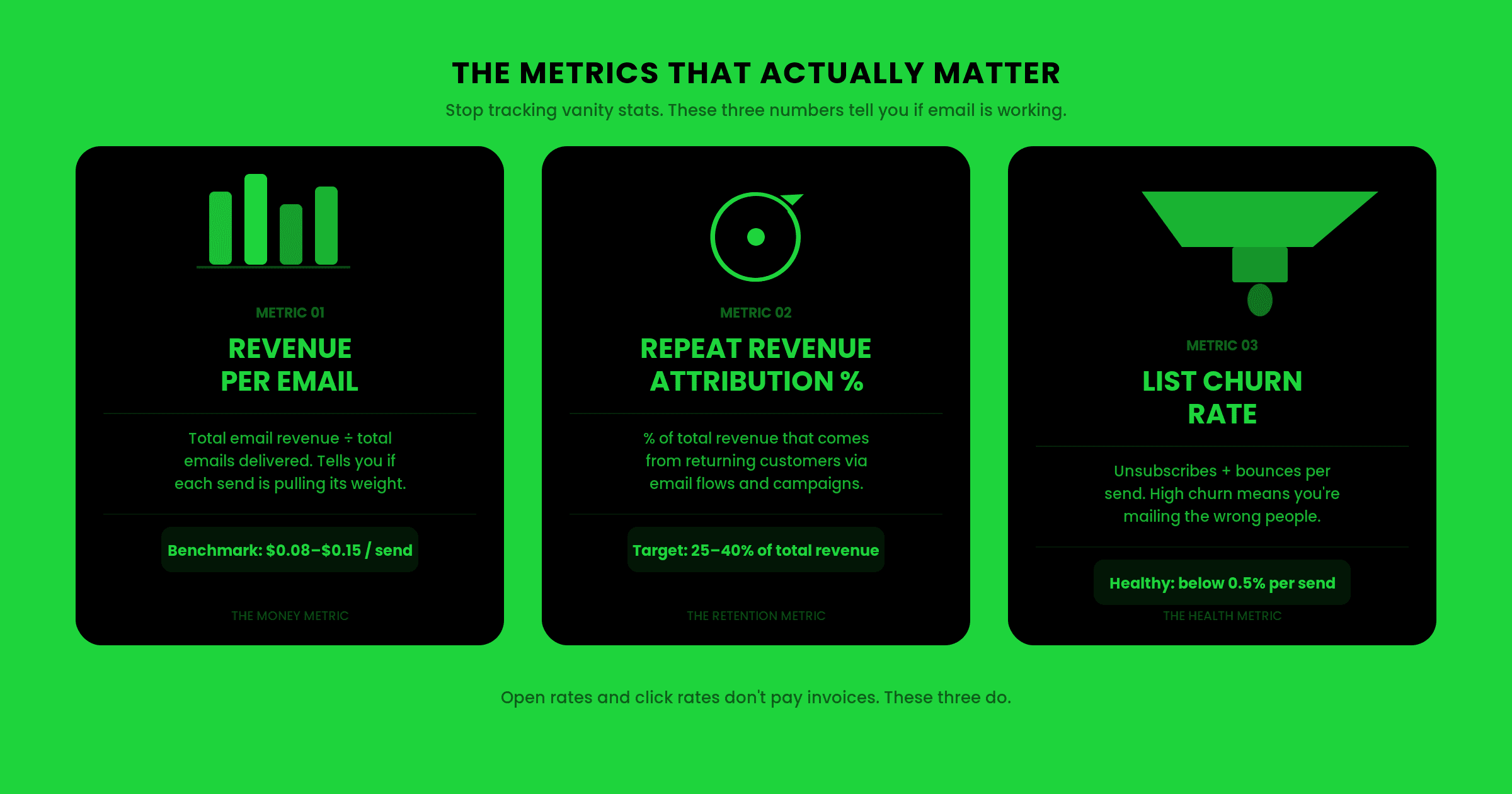
The metric that matters is revenue per email sent.
Total email revenue divided by total emails sent, broken down by segment and by flow. HubSpot research puts email ROI at $36 to $42 per dollar spent, the highest of any digital marketing channel. That return only materializes when you are tracking the right number inside the channel.
Two supporting metrics sharpen the full picture. Repeat revenue attribution: of total monthly revenue, what percentage came from returning customers reached by email? Industry benchmarks put this at 35 to 50 percent for programs with strong segmentation. Below 25 percent, the email program is not doing its job.
List churn rate: healthy programs run 0.1 to 0.3 percent unsubscribes per send. Above 0.5 percent is a clear signal that frequency is too high or content is missing the mark.
Track those three in a weekly view. Revenue per email is the number that tells you where to focus next.
Building an email system, not just an email calendar
The brands that scale email revenue stop thinking about what to send this week. They start building systems that run without them.
That shift looks like this in practice.
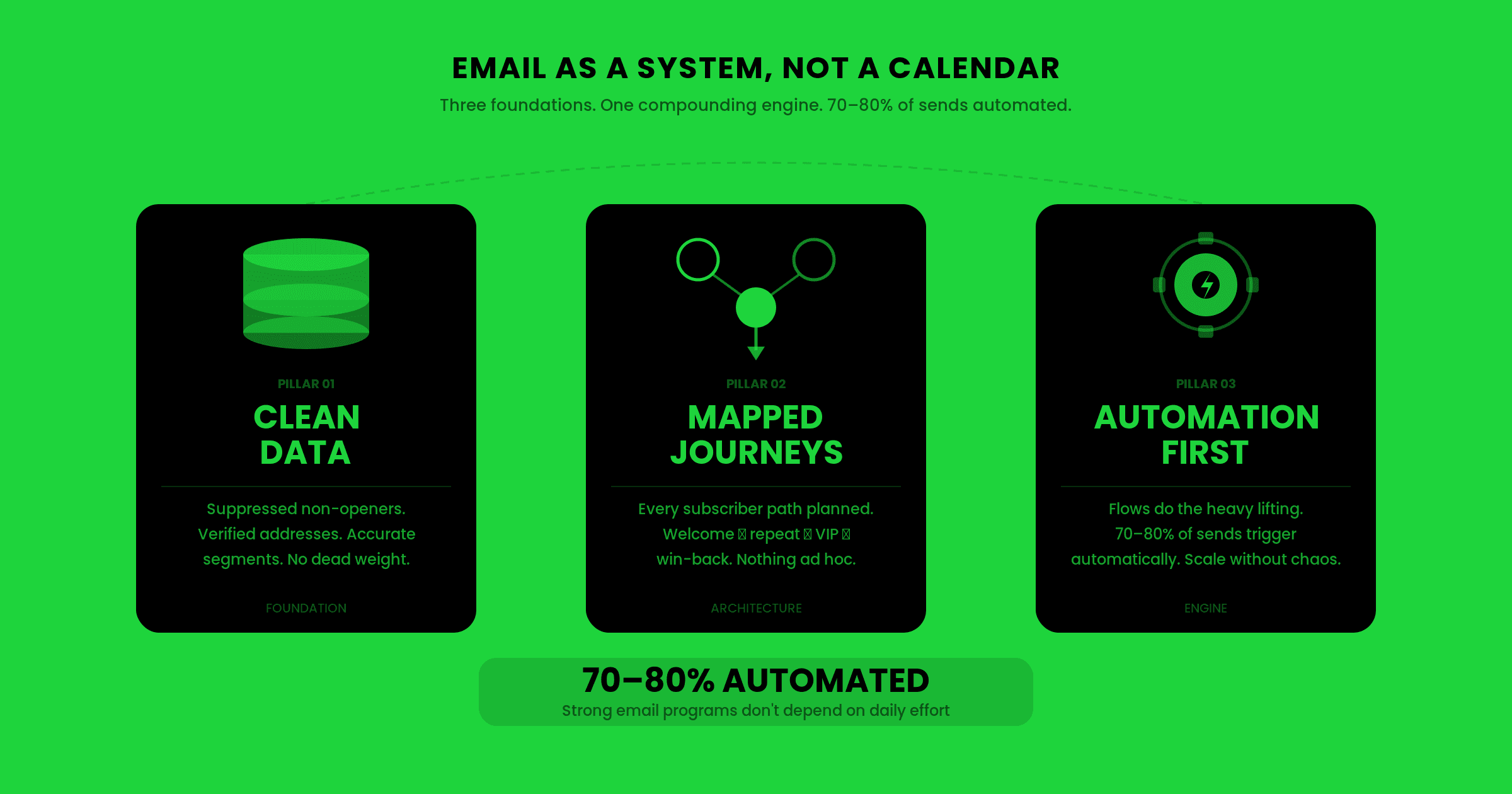
One platform with clean data. If customer information is spread across multiple tools, consolidation is the first step. Klaviyo is the standard for Shopify-based e-commerce. Clean the list, remove duplicates, and know the actual active subscriber count rather than a number inflated by addresses that have not opened in two years.
Mapped customer journeys. Not complicated flowcharts. Just clear answers to: what does a new subscriber receive? What does a repeat buyer receive? What does a dormant customer receive? If the answer to all three is the same campaign blast, the system does not exist yet.
Automation-first volume. The standard ratio for well-run programs: roughly 70 to 80 percent of email sends triggered by customer behavior. Abandoned cart, post-purchase onboarding, browse abandonment, win-back sequences. These flows run around the clock without requiring a new creative decision every week. The remaining 20 to 30 percent is campaign sends for product launches and time-sensitive promotions.
The brands using this infrastructure model in markets like Philadelphia and Denver consistently outperform brands running on campaign calendars alone. The list size is often smaller. The system is better.
Denver has a natural email marketing advantage
Denver's outdoor market, high household income, and seasonal buying patterns create a specific opportunity for e-commerce brands willing to build email systems around how customers actually behave.
The seasonal cycles are predictable. That means timing can be precise. Customer interests cluster around a handful of strong categories. That makes segmentation more straightforward than in broader, more diffuse markets. Purchasing power is real. That means repeat customers are genuinely worth pursuing.
The brands winning at email in this market are not the most creative. They are the most systematic. They segment before they send. They measure revenue, not opens. They build automation that compounds over time without constant attention.
If repeat purchase rates are sitting below 8 percent, the list is probably fine. The system is not.
Running an e-commerce brand in Denver? Mailing Monk builds Klaviyo email systems that turn one-time buyers into repeat customers. Flat $1,500 per month. Explore our Denver email marketing services

Our mission is simple: help brands grow through better emails. We focus on strategy, design, and data to turn the inbox into a high-performing sales channel; without the noise. We believe great email marketing is clear, personal, and built to last.