Learn how to build a post-purchase flow in Klaviyo that turns one-time buyers into repeat customers. Strategy for segmentation, timing, and automation.
The most expensive customer you will ever acquire is the one who buys once and disappears.
Think about that for a second. You spent money on ads, SEO, maybe even influencer partnerships to get someone to your store. They bought. And then nothing. No follow-up. No relationship. Just a shipping confirmation and silence.
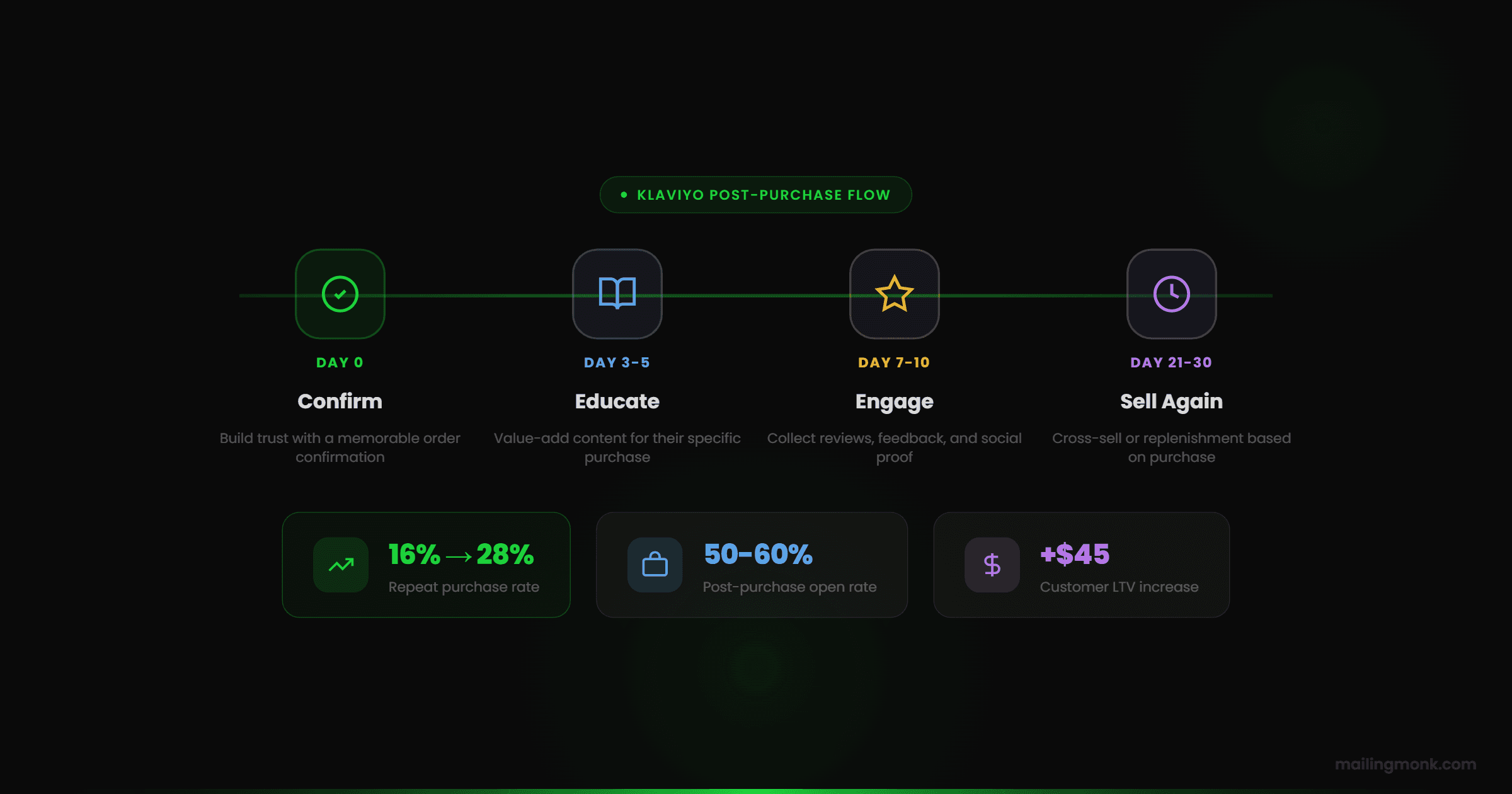
According to Klaviyo's own benchmark data, post-purchase emails see open rates between 50% and 60%. That is double what most promotional campaigns get. Your customers are paying attention right after they buy. The question is whether you are saying anything worth hearing.
Most e-commerce brands treat post-purchase email like a receipt. A single confirmation, maybe a tracking number, and then they go quiet until the next sale hits. That approach leaves serious money on the table. Industry data from Statista's e-commerce retention research shows that acquiring a new customer costs five to seven times more than retaining an existing one. Your post-purchase flow in Klaviyo is the single most efficient place to start building that retention.
This post breaks down how to build one that actually drives repeat revenue, not just confirms an order.
Why post-purchase is the highest-leverage flow you can build
Here is an opinion that will get some pushback: your post-purchase flow matters more than your welcome series.
Welcome emails go to people who might buy. Post-purchase emails go to people who already did. They already trust you enough to hand over their credit card. That trust is a window, and it closes faster than most brands realize.
HubSpot's research on customer retention puts it plainly: increasing retention by just 5% can boost profits by 25% to 95%. The post-purchase flow is where retention starts. Not in some loyalty program six months later. Right now, in the 48 hours after someone receives their order.
E-commerce brands generating 25% or more of their revenue from email almost always have a post-purchase sequence doing heavy lifting. The ones stuck at 5% to 10% usually have a single order confirmation and nothing else.
If you are running a Klaviyo account for a Denver outdoor brand or a Philadelphia DTC startup, the math is the same. Post-purchase is where you turn a transaction into a relationship.
The four emails every post-purchase flow needs
Not three. Not seven. Four is the number where you cover the critical touchpoints without overwhelming someone who just bought from you.
Email one: the order confirmation that does more than confirm.
Send this within two hours of purchase. Yes, include the order details. But add something unexpected. A short note from the founder. A product care tip. A behind-the-scenes photo of your warehouse team packing orders. This email has the highest open rate in your entire Klaviyo account. Use it.
The goal is not to sell again. The goal is to make the customer feel like they made a good decision.
Email two: the value-add (day three to five).
This is the email most brands skip entirely, and it is the one that does the most work for retention. Send a piece of content that helps the customer get more out of what they bought.
If you sell skincare, send a routine guide. If you sell supplements, send dosage tips and pairing suggestions. If you sell apparel, send styling ideas. The point is to educate, not to pitch.
Brands that include educational content in their post-purchase sequence see repeat purchase rates climb significantly. Educational content typically drives higher engagement than promotional sends because it demonstrates value beyond the immediate sale.
Email three: the engagement check (day seven to 10).
Ask for a review. Request feedback. Send a short survey. This email accomplishes two things at once. It gives you social proof you can use in future marketing, and it keeps the customer engaged with your brand during the critical window before they forget about you.
One strong opinion here: do not offer a discount in exchange for a review. It cheapens the experience and trains customers to expect payment for engagement. A simple "How did we do?" with a one-click rating works better.
Email four: the replenishment or cross-sell (day 21 to 30).
This is where revenue lives. By day 21, the customer has received their product, used it, and formed an opinion. If the first three emails did their job, they feel good about your brand.
Now you can make a relevant recommendation. Not a generic "you might also like" block. A specific suggestion based on what they actually bought. Klaviyo's product recommendation engine handles this natively. According to Klaviyo's data on personalized recommendations, customers who receive personalized product suggestions are significantly more likely to become repeat buyers compared to those receiving generic offers.
Segmentation makes or breaks the flow
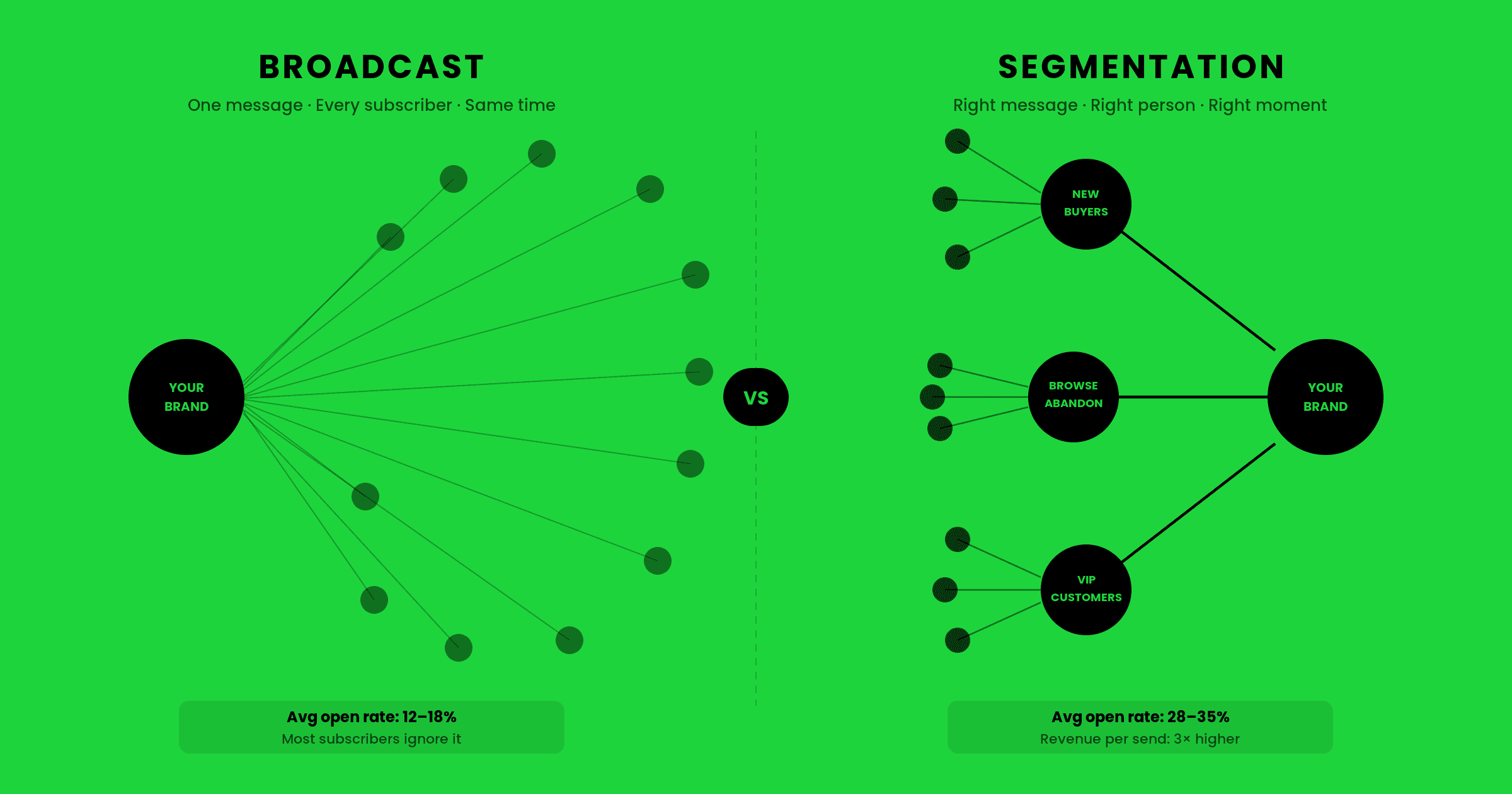
Here is where most Klaviyo post-purchase flows fall apart. Brands build one sequence and send it to every single customer regardless of context.
A first-time buyer needs a completely different experience than someone on their fifth order. A customer who spent $200 should not get the same follow-up as someone who spent $29. And a customer who opened every email you have ever sent does not need the same re-engagement nudge as someone who has never clicked.
At minimum, split your post-purchase flow into two branches.
Branch one: first-time buyers. These people do not know you yet. They need reassurance, education, and a reason to come back. Lead with product value, not promotions. The goal is to get them to a second purchase within 60 days.
Branch two: repeat customers. These people already trust you. They do not need the founder story again. They need recognition, loyalty signals, and smarter product recommendations. Consider VIP messaging, early access to new products, or referral program invitations.
For Kansas City food and beverage brands selling consumable products, this split is especially important. A first-time hot sauce buyer and a repeat subscriber need fundamentally different post-purchase journeys.
Advanced teams add a third branch based on purchase value. High-AOV customers get a more premium experience, possibly including a personal thank-you video or a dedicated customer success touchpoint. This sounds like overkill for smaller brands, but high-value customers who receive premium post-purchase treatment are significantly more likely to purchase again. Investing in VIP treatment for large orders consistently outperforms one-size-fits-all flows.
The five mistakes killing your post-purchase revenue
These are not theoretical. These are patterns that show up repeatedly in Klaviyo accounts across the e-commerce industry.
Mistake one: one email and done.
The single order confirmation with no follow-up is still the most common post-purchase "strategy" in e-commerce. It is not a strategy. It is a missed opportunity.
A single confirmation email leaves 100% of the retention potential on the table. If you do nothing else after reading this post, add at least one value-add email three days after purchase. That one addition alone can move your repeat purchase rate.
Mistake two: identical flows for every customer type.
Sending the same four emails to a first-time buyer and a loyal VIP is like giving the same onboarding presentation to a new hire and the CEO. One size fits nobody. Industry benchmarks show unsegmented flows generate 35% to 45% higher unsubscribe rates than segmented ones.
Mistake three: pitching too early.
The customer just bought from you. They do not want another offer in their inbox 12 hours later. Promotional emails sent within 48 hours of purchase see significantly higher spam complaint rates.
Lead with value for the first two touchpoints. Education, tips, and community building earn the right to sell later.
Mistake four: no win-back trigger.
Roughly 18% to 25% of new e-commerce customers become inactive within 60 days if there is no re-engagement effort. Your post-purchase flow should include a conditional split at the 30-day mark. If the customer has not returned, trigger a win-back sequence. If they have purchased again, suppress the win-back and move them to a loyalty track.
Mistake five: ignoring send timing and mobile experience.
More than 60% of email opens happen on mobile devices. If your post-purchase emails are not mobile-optimized, you are losing readers before they get to your content.
Send timing matters too. A/B test your send times in Klaviyo. The difference between sending at 10 AM and 2 PM can mean a 15% to 20% swing in open rates depending on your audience.
Measuring what matters
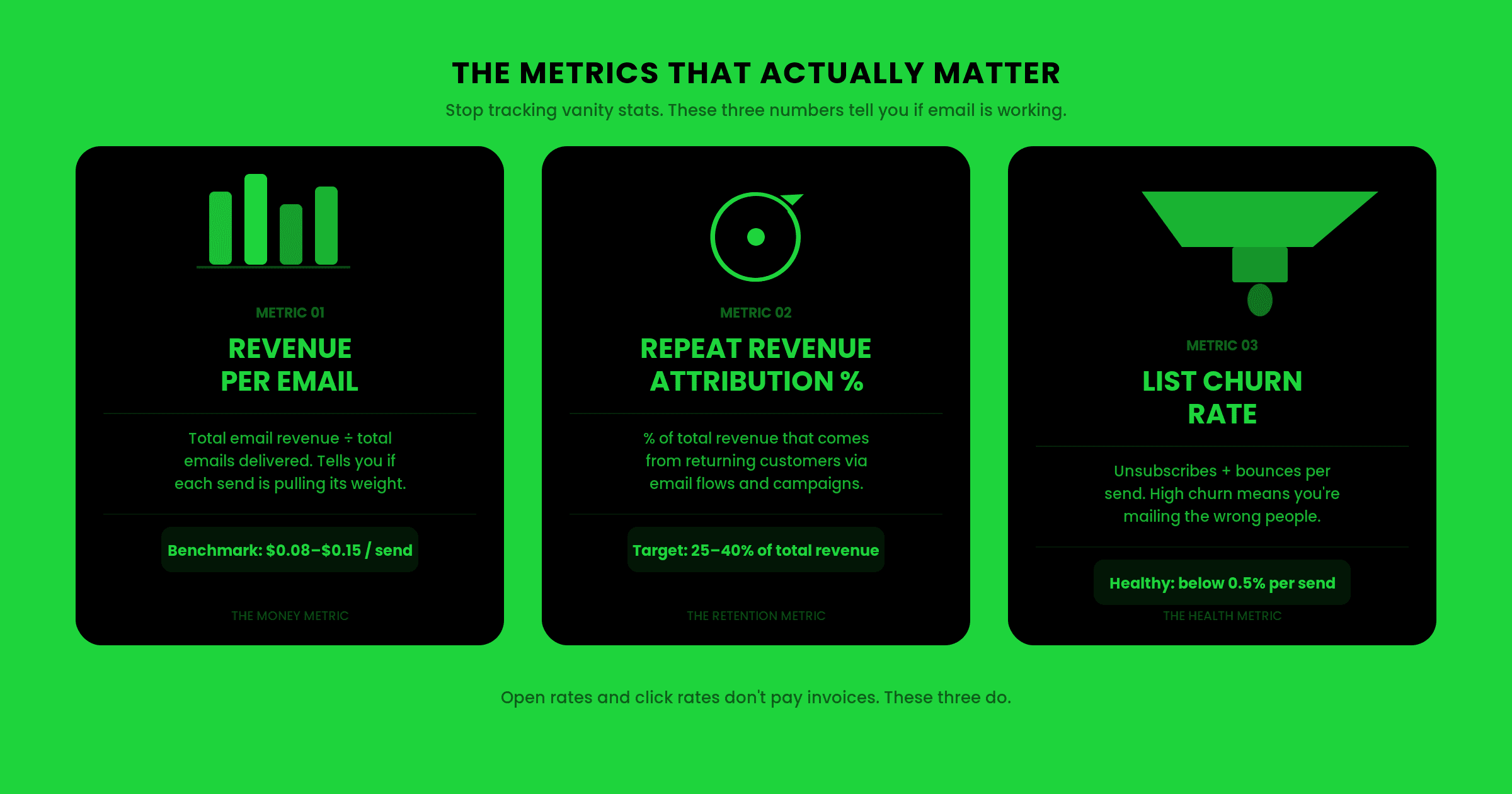
Do not track vanity metrics. Open rates tell you if the subject line worked. They do not tell you if the flow is driving revenue.
Here is what to watch in your Klaviyo dashboard.
Repeat purchase rate within 90 days. This is the number that matters most. A healthy post-purchase flow should push this to 18% to 30% depending on your product type and price point. If you are below 15%, something in the flow is broken.
Revenue per recipient. Not revenue per email. Revenue per recipient tells you how much each person who enters the flow is worth to your business. Track this monthly and compare across flow versions when you run A/B tests.
Click-through rate on email two (the value-add). This email is your bellwether. If people are clicking on your educational content, they are engaged. If they are not, your content is not relevant enough. Target 12% to 18% CTR on this email.
Unsubscribe rate. Keep this below 0.5% across the entire flow. If it spikes after any specific email, that email is the problem. Fix or remove it.
Track these metrics by cohort. Compare customers who entered the flow in January versus March. Compare first-time buyers versus repeat customers. Cohort analysis reveals whether your flow is actually improving over time or just treading water.
For Philadelphia e-commerce brands running seasonal products, cohort tracking is essential. A post-purchase flow that works in Q1 might underperform in Q4 when customer behavior shifts around the holidays.
What a real post-purchase turnaround looks like
Here is an example based on common patterns across the e-commerce industry.
A mid-size DTC brand doing around $2 million in annual revenue had a single-email post-purchase setup. Order confirmation, tracking link, done. Their repeat purchase rate sat at 16%. Customer LTV was stagnant.
After implementing a four-email post-purchase flow with the structure outlined above, segmented by first-time versus repeat buyers, with personalized product recommendations in email four, the results over 90 days were clear.
Repeat purchase rate went from 16% to 28%. Post-purchase email revenue climbed from roughly $8,000 to $18,000 per month. Customer LTV increased by about $45 per customer. And unsubscribe rates stayed flat at 0.3%.
None of this required new ad spend. No new traffic. No new products. Just a smarter conversation with people who already bought.
San Diego beauty and wellness brands running subscription-adjacent models see even stronger results from post-purchase flows because the replenishment trigger aligns naturally with the product lifecycle.
Build this before you spend another dollar on acquisition
Post-purchase email is not a nice-to-have. It is the fastest path to making your existing customer base more profitable.
If you are running a Klaviyo account right now, open your flows dashboard. Look at what happens after someone buys. If the answer is "order confirmation and nothing else," you have the single biggest revenue opportunity sitting untouched in your account.
Start with four emails. Segment by at least two customer types. Measure repeat purchase rate at 90 days. That is the foundation.
Everything else, dynamic product feeds, advanced conditional splits, predictive analytics, is optimization on top of a working system. Get the basics right first.
Working with an e-commerce brand? Mailing Monk specialises in Klaviyo retention email for DTC brands. We serve e-commerce businesses across the US, including Denver, Philadelphia, Kansas City, and San Diego. Flat $1,500/month. No retainer games.

Our mission is simple: help brands grow through better emails. We focus on strategy, design, and data to turn the inbox into a high-performing sales channel; without the noise. We believe great email marketing is clear, personal, and built to last.