Your Klaviyo list has buyers, browsers, and dead weight. Here's how to segment them into six groups that actually change your email revenue.
You have 12,000 subscribers in Klaviyo. You send a campaign every Tuesday. Open rate looks decent, maybe 22%. But revenue per email has been flat for months and your repeat purchase rate won't budge. You're doing the work. The money just isn't following.
Here's what's actually happening. That 12,000-person list contains at least four different audiences. People who bought last week. People who haven't opened an email since January. People who browse your site every Thursday but never add to cart. And people who placed one order eight months ago and forgot you exist.
You're sending all four groups the same email. Same subject line. Same product grid. Same 15% off. The buyer who just spent $200 doesn't need a discount. The subscriber who hasn't clicked in 90 days is dragging your sender reputation into the ground. And the one-time purchaser who almost came back? She needed a completely different message at a completely different time.
Klaviyo segmentation fixes this. Not in theory. In the next 30 minutes. Six segments, six filters, one sending framework that changes the economics of every campaign you send from here forward.
Your "list" is actually six different audiences pretending to be one
Most e-commerce brands think about their email list as a single group. Subscribers. People who opted in. That framing is the problem.
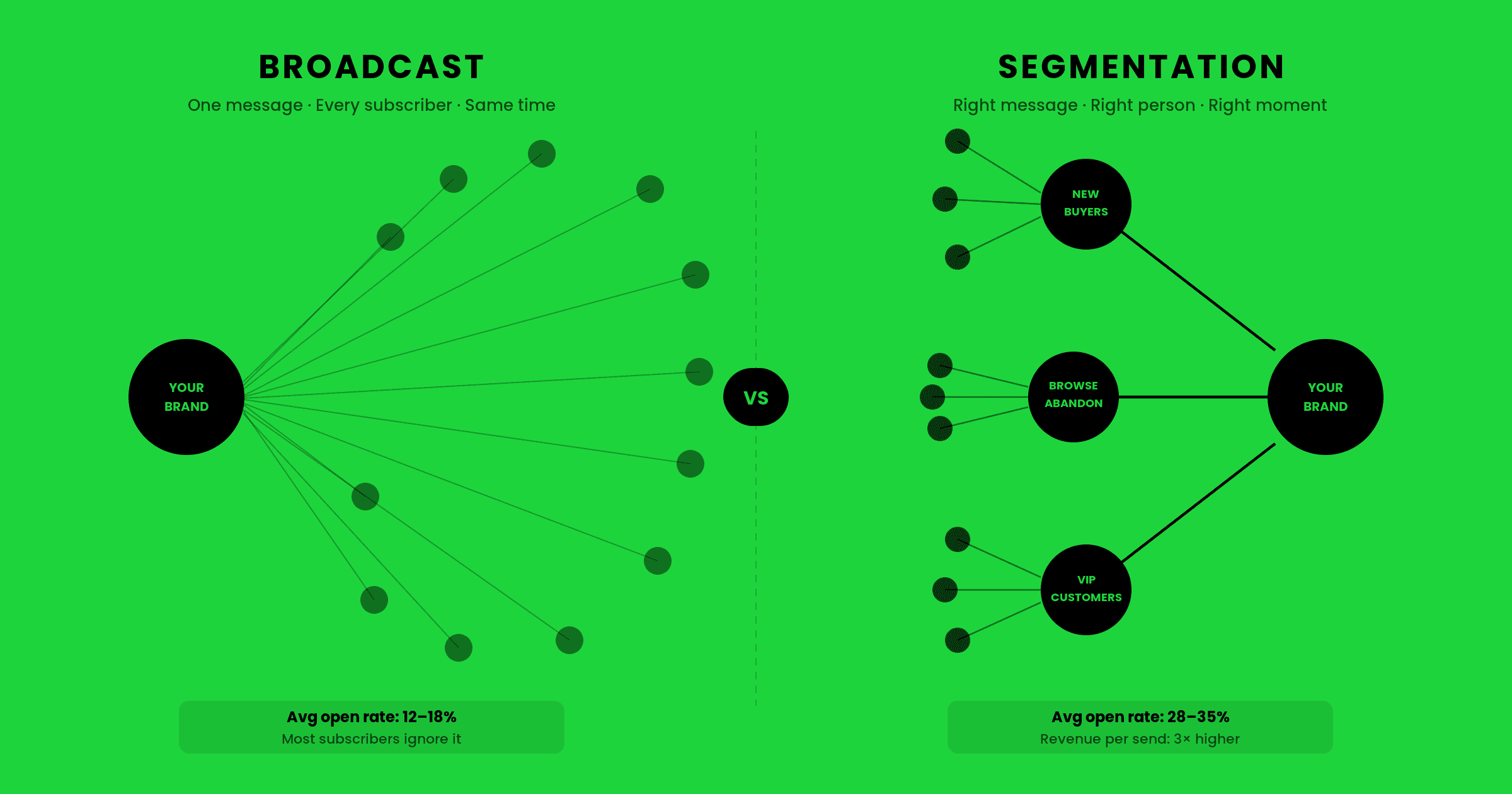
Klaviyo's 2025 benchmark data tells a sharper story. Automated flows generate 41% of total email revenue from just 5.3% of sends. Revenue per recipient on those flows runs nearly 18 times higher than campaigns. Why? Because flows are inherently segmented. Someone abandoned a cart, so they get the cart recovery sequence. Someone just subscribed, so they get the welcome series.
Campaigns don't have that built-in targeting. So brands default to the full list. Everyone gets the same Tuesday blast. And the metrics tell the story: Klaviyo's own data shows segmented campaigns generate 760% more revenue than unsegmented ones. Not a little more. Seven and a half times more.
The six segments below split your list into the audiences that already exist inside it. You're not creating artificial groups. You're just finally treating different customers differently.
Klaviyo segmentation in practice: the six segments and how to build them
Go to Audience > Lists & Segments in Klaviyo. Click Create List / Segment. Select Segment. Then build these, in this order. The engagement segments come first because they protect your deliverability.
1. Engaged 30 Days (your safe-send list)
Under "What someone has done," choose Opened Email, set to in the last 30 days. Click OR. Add Clicked Email, same 30-day window.
This is the only segment that should receive your regular weekly campaigns. These people are active. They want your emails. Send to them and your open rates stay healthy, your click rates climb, and Gmail keeps you in the primary inbox.
2. Engaged 60 Days (your launch list)
Same setup, but 60-day window for both conditions.
Wider net for bigger moments. Product launches, seasonal sales, major announcements. You want reach without wrecking your sender reputation. This segment gives you that.
3. At-Risk (former buyers going silent)
Start with Placed Order > at least once > over all time. Then AND: Opened Email > zero times > in the last 60 days. Then AND: Clicked Email > zero times > in the last 60 days.
These people bought from you. They trusted you with their money. Now they've gone dark. Every week you don't re-engage them is a week closer to losing them permanently. Win-back flows only. Do not include them in regular campaigns. Consider a supplement brand on Shopify with 300 at-risk contacts sitting in Klaviyo. That's thousands of dollars in dormant lifetime value. A targeted win-back sequence can recover 10-15% of them, according to Klaviyo's segmentation framework. Brands running this kind of Klaviyo segmentation in markets like Philadelphia and beyond are recapturing revenue that would otherwise churn to zero.
4. Unengaged 90 Days (the dead weight killing your inbox placement)
Opened Email > zero times > in the last 90 days AND Clicked Email > zero times > in the last 90 days.
This is the segment most brands refuse to deal with. These contacts are not just inactive. They're actively hurting you. Gmail, Yahoo, and Outlook track engagement signals. When a large chunk of your list ignores every email you send, inbox providers start routing ALL your emails to spam, including the ones going to your most engaged customers.
Litmus's 2025 State of Email report found that brands with poor list hygiene see inbox placement drop below 75%. One in four of your emails never reaches any inbox. You're paying for that damage with every unsegmented blast.
Send this group one sunset sequence. "We miss you, here's a reason to come back." If they don't engage, suppress them. Your deliverability will improve within weeks.
5. VIP Customers (your most valuable 5-10%)
Placed Order > at least 3 times > over all time OR (using the Properties filter) Total CLV > is at least > 500.
Your VIPs don't need another 15% off coupon. They're already buying. What they need is recognition. Early access to new products. A personal thank-you from the founder. A loyalty perk nobody else gets.
E-commerce brands in markets like Kansas City and Denver that segment their VIPs and treat them differently see measurably higher retention. The ones lumping VIPs in with everyone else are training their best customers to wait for the same discount everyone gets.
6. One-Time Purchasers (your single biggest revenue lever)
Placed Order > exactly 1 time (or if Klaviyo requires it: at least 1 time AND at most 1 time).
This segment is where the money is. Repeat buyers have 9 times the lifetime value of one-time purchasers, according to Klaviyo's benchmark data. Getting even 10% of your one-time buyers to place a second order changes your unit economics.
Every email to this segment should push toward that second purchase. Education about complementary products. Social proof from repeat buyers. A post-purchase flow that triggers based on their specific product and purchase timing, not a generic "thanks for buying" drip.
The sending framework that makes segments actually work
Klaviyo segmentation doesn't generate revenue by itself. Segments sitting in your dashboard are just filters. The sending framework is what turns them into money. Here's the rule: you never send to your full list again. Every campaign picks a segment.
Regular weekly campaigns (product features, educational content, weekly promos) go to Engaged 30 Days only. Product launches and major sales go to Engaged 60 Days. Win-back sequences go to At-Risk only. Sunset sequences go to Unengaged 90 Days only. VIP exclusives go to VIP Customers. Second-purchase campaigns go to One-Time Purchasers.
And here's the rule most guides skip: exclude anyone who subscribed in the last 14 days from every campaign. Build a quick "New Subscribers" segment (use Date Added > in the last 14 days). Your welcome flow is already talking to them. Stacking campaigns on top of an active welcome series creates fatigue and trains new subscribers to tune you out before the relationship starts.
This framework works whether you have 1,500 subscribers or 150,000. The segments are behavior-based. They scale with your list automatically.
What actually changes when you start segmenting
The first thing you'll notice is your open rates jump. Not because you wrote better subject lines. Because you stopped sending to people who were never going to open. HubSpot's 2025 email report puts the average e-commerce email open rate at 15.68%. Brands with clean segmentation consistently hit 30-45%. The math is simple: send to people who want your emails and more people open your emails.
The second thing is your click-through rate improves. When a VIP gets an exclusive offer instead of the same blast everyone else receives, they click. When a one-time buyer gets a targeted cross-sell instead of a generic promo, they click. Relevance drives action.
The third thing takes longer to show up but matters most. Your sender reputation recovers. Gmail starts trusting your sends again. Emails land in primary instead of promotions. The subscribers who were already engaged start seeing your emails more consistently because you stopped dragging your reputation down with dead-weight contacts.
A store doing $2M in annual revenue that moves even 5% more of its one-time buyers to repeat purchasers is looking at $100K-$200K in additional lifetime value. That's not from a new ad channel or a website redesign. That's from six segments and a sending framework you can build this afternoon.
Start here. Build the six. Send smarter.
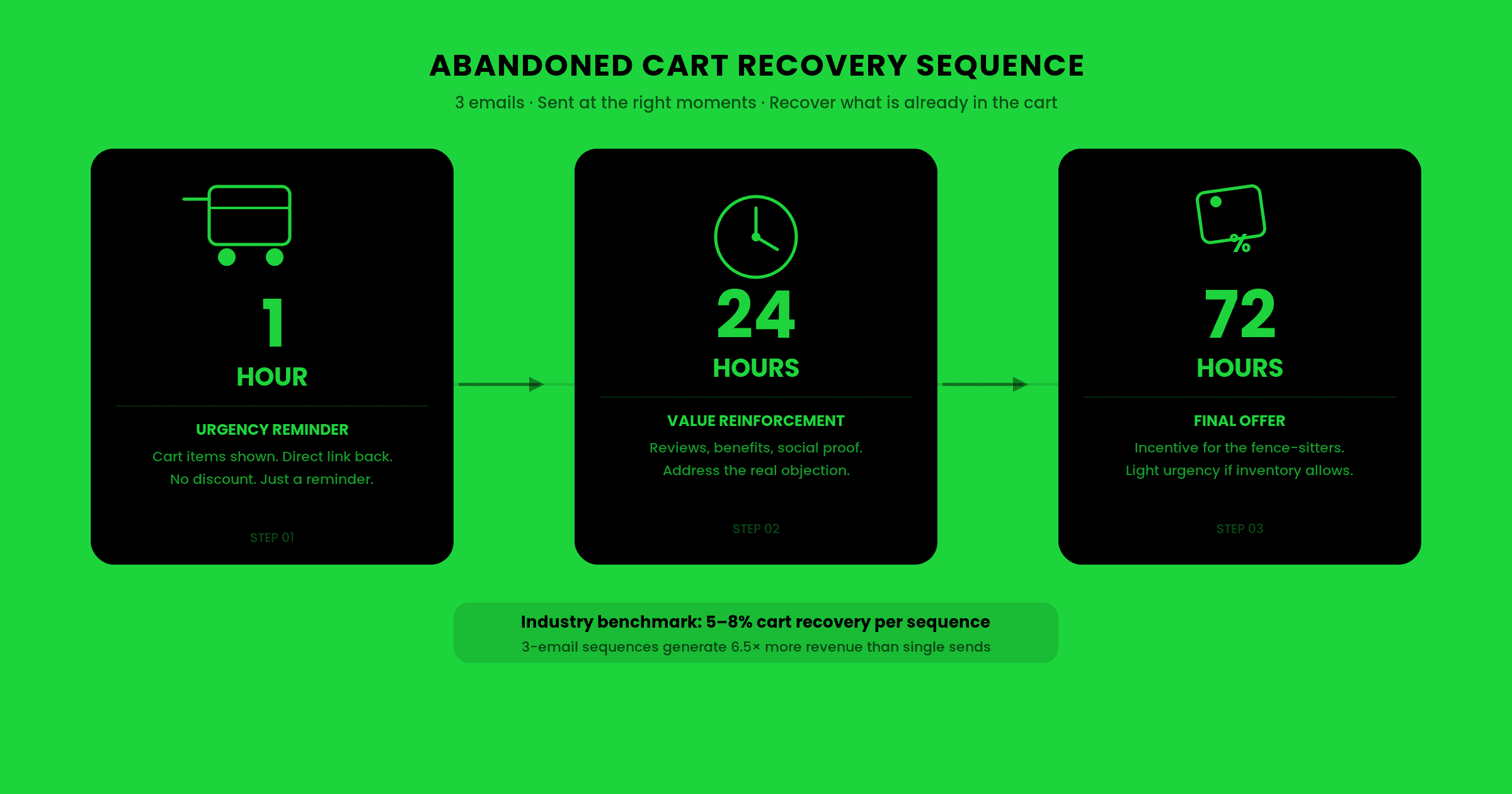
Proper Klaviyo segmentation isn't an advanced tactic you get to later. It's the foundation that makes everything else in your email program work. Your abandoned cart flow performs better when unengaged contacts aren't clogging your sender reputation. Your campaigns convert higher when they reach people who actually want them. Your email revenue grows because you're finally sending the right message to the right person at the right time.
Six segments. Thirty minutes. Zero additional cost beyond the Klaviyo plan you're already paying for. The difference between the brands earning 40% of revenue from email and the ones stuck at 10% isn't talent or budget. It's whether they treat their list as one audience or six.
Build the segments. Apply the framework. Check back in 30 days and look at the numbers.

Our mission is simple: help brands grow through better emails. We focus on strategy, design, and data to turn the inbox into a high-performing sales channel; without the noise. We believe great email marketing is clear, personal, and built to last.