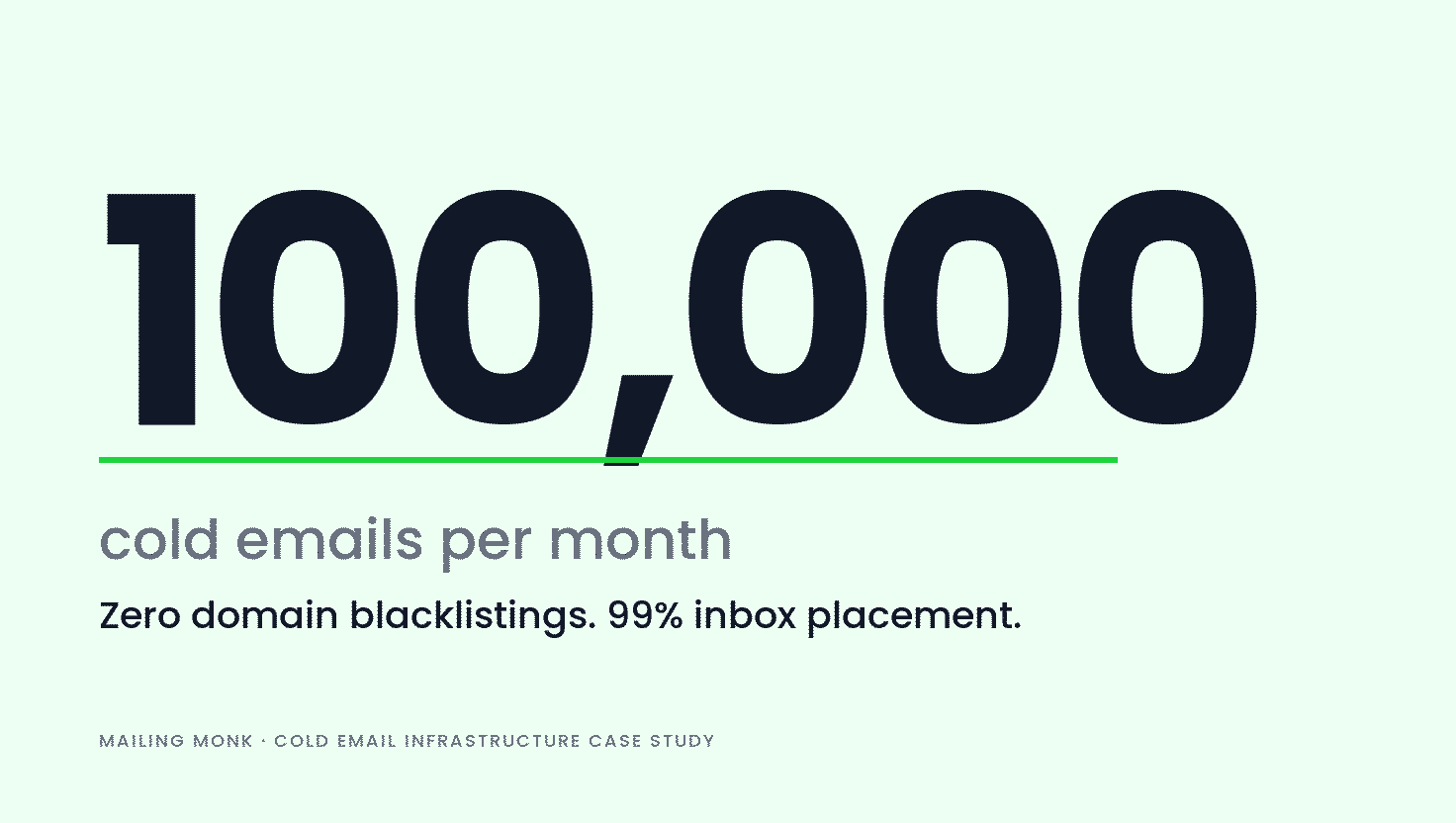
How Mailing Monk runs 51 sending domains and 153 mailboxes to send 100,000 cold emails per month with zero domain blacklistings and 99% inbox placement. The operator's manual: the math, the DNS discipline, the permanent-warmup protocol, the cost breakdown, and the five rules that compound.
Most cold email infrastructure dies in its first year.
A few sending domains get flagged. Inbox placement drifts from 80% to 50%. Reply rates fall off a cliff. By month nine, the agency is rebuilding from scratch or quietly losing the client.
We watched the same pattern play out across ten different client setups before we built our own.
Today, Mailing Monk operates 51 sending domains and 153 mailboxes provisioned through Premium Inboxes' infrastructure. The system moves 100,980 cold emails every month at full operational capacity. Inbox placement sits above 99% across all 51 domains. Spam complaint rate stays under 0.1%, measured every Monday morning via Google Postmaster Tools.
Across over 1 million cold emails sent on this infrastructure, we have logged exactly zero domain blacklistings.
Premium Inboxes has also published a companion case study covering the infrastructure behind this setup. Where that case study tells the what, this one is the operator's manual. The math, the discipline, the cost, and the five rules that compound to keep the whole thing alive year over year.
If you operate B2B cold email at scale, the next 12 minutes will be the highest-leverage reading you do this week.
The math the agencies that survive get right
Cold email scale is not a creative problem. It is an arithmetic problem with hard constraints, and the agencies that win are the ones that respect the math.
Gmail and Microsoft 365 tolerate a sending mailbox pushing 30 cold emails per day. Push 50, and the mailbox starts triggering provider-side throttling. Push 100, and you are watching the domain's sender reputation collapse in real time.
Stack more than three sending mailboxes onto a single domain and the domain starts reading as a sending farm to inbox classifiers. The trust band Gmail extends to small-business senders evaporates. We have seen this happen on day six of a client's previous setup, where an aggressive operator had put eight mailboxes on one domain and watched placement halve inside a week.
So you cap mailboxes per day. You cap mailboxes per domain. And then you back into the only variable left: the domain count.
Run the math. Thirty cold emails per mailbox per day. Three mailboxes per domain. Twenty-two sending days per month, because we send Monday to Friday only and treat weekends as off the calendar entirely. That gives you 1,980 emails per domain per month. To hit 100,000, you need 51 sending domains. Exactly 51.
We send 100,980 cold emails a month using 51 sending domains connected to infrastructure managed through Premium Inboxes. If we wanted to send 200,000, we would scale to 102 domains. The formula stays fixed. The variable is just how big the machine needs to be.
Most agencies get this math wrong in the same direction. They try to compress. Five mailboxes per domain instead of three. Forty emails per mailbox per day instead of thirty. Sending on weekends to squeeze out more volume. Each compression looks small in isolation. Stacked together, they produce the infrastructure that dies in nine months.
The discipline is to refuse the compression even when the calendar pressure asks you to bend.
The three DNS records that decide everything
Three lines of DNS configuration determine whether a cold email lands in the primary inbox or the spam folder. Most cold email setups we have rebuilt had one of them right. The good ones had two. The bad ones had none. The question every operator should be able to answer is whether their DMARC is at p=reject or still parked at p=none three months after launch.
SPF tells receiving servers which IP addresses are authorised to send mail on behalf of a domain. We use hard-fail (-all) on every domain in our infrastructure. Soft-fail (~all) is the more lenient version most cold email setups use, which is exactly why we do not use it.
DKIM cryptographically signs each outbound email so the receiver can verify the message has not been tampered with in transit. We use 2048-bit keys and rotate them every 12 months as a hygiene practice.
DMARC is the record that does the most work. It tells receiving servers what to do when SPF or DKIM fails. It tells the domain owner when failures happen. And critically, it signals to Gmail and Microsoft 365 that the domain owner is operating with adult-level email authentication discipline. Domains at DMARC p=reject get measurably better inbox placement than domains at p=none, holding everything else constant.
We progress every domain through three DMARC stages over four to six weeks. Week one to two, p=none. We watch reports, identify any unauthorised senders, confirm SPF and DKIM are passing across legitimate mail. Weeks two through four, p=quarantine. Anything failing authentication lands in the recipient's spam folder. Reports keep coming in. Week four onwards, p=reject. Anything failing authentication gets dropped at the receiver.
Every DNS configuration is verified through MXToolbox before any inbox enters warm-up. We rerun the same checks across all 51 domains monthly. As of May 2026, every domain in our infrastructure runs at p=reject. None has fallen back.
The agencies whose infrastructure decays usually share a single failure point. They get to p=quarantine, see a few false positives in the reports, panic, and roll back to p=none. Then they never come back. Within a year, their inbox placement has eroded ten or fifteen points.
DMARC progression is non-negotiable. p=none is a launch state, not an operating state.
Why we never stop warming up
Warm-up is the gradual ramp of sending volume on a new mailbox to build positive sender reputation with inbox providers. Skip it, send thirty cold messages from a fresh mailbox on day one, and the reputation hit is immediate and usually unrecoverable.
Most operators know this. The standard play is a four-week warm-up at launch, then full cold rotation, then the warm-up tool gets disabled and the inbox sends nothing but cold outbound from there.
That is the play we refuse to run.
Our protocol has three rules. The first two are conventional. The third is the one most agencies skip and the one that matters most.
Rule one. No mailbox enters cold outreach until it has completed at least 28 days of structured warm-up. The ramp goes 5, 10, 15, 20 messages per day across weeks one through four. By the end of week four, the mailbox has sent close to 350 warm-up messages, has received and replied to inbound warm-up traffic, and has built a baseline reputation visible to Gmail's classifiers.
Rule two. The mailbox must hold 85% inbox placement across five consecutive days before it enters cold rotation. Not promotional tab. Not spam. Primary inbox. Anything below 85% means the mailbox is not yet trusted by enough providers to handle real cold outreach, and pushing it into rotation will damage the rest of the domain. Mailboxes that fail this gate get an extended warm-up window. Mailboxes that fail twice get retired and replaced with a backup mailbox already mid-warm-up.
Rule three. Warm-up never stops. Every mailbox in our infrastructure runs warm-up traffic at 10 to 15 emails per day permanently, even after entering full cold rotation. The cold load uses 30 of the daily ceiling. The warm-up load uses 10 to 15 more. The total per-day per-mailbox sits at around 40 to 45.
That third rule is the unfair advantage. Permanent low-volume warm-up signals to inbox providers that this mailbox is doing what real human mailboxes do: sending some messages, receiving some, replying to a portion. It looks indistinguishable from a small-business inbox doing its job. Reputation holds steady instead of decaying month by month.
Most agencies disable warm-up at launch because the per-inbox warm-up tool fee adds up across 100+ mailboxes. We treat that fee as the cheapest insurance in the entire stack. The 99% inbox placement number we quote at the top of this piece is not a launch metric. It is a year-three metric, and rule three is the reason it has held.
What 100,000 cold emails actually cost
There is a moment in every cold email agency's growth where the founder runs the numbers on infrastructure cost and realises the unit economics do not work. The campaigns are profitable. The clients are happy. But the per-mailbox spend on Google Workspace is eating the margin.
That moment is what pushed us to standardise on Premium Inboxes.
Premium Inboxes prices mailboxes at $3.50 per month. Google Workspace prices the equivalent capability at $6.00 per user. Mailforge sits at $15.00 per inbox. At 153 mailboxes, those prices spread out like this.
Provider | Monthly mailbox cost (153) | Additional domain expenses | Total monthly cost | Cost per 1,000 emails |
|---|---|---|---|---|
Premium Inboxes | $535.50 | ~$51.00 | $586.50 | $5.87 |
Google Workspace | $918.00 | ~$51.00 | $969.00 | $9.69 |
Mailforge | $2,295.00 | ~$51.00 | $2,346.00 | $23.46 |
Premium Inboxes' mailbox capacity runs at 60% the cost of Google Workspace and 25% the cost of Mailforge for equivalent sending volume. Across a 12-month operational year, that is $4,590 saved versus Google Workspace before factoring in the operational cost of managing 51 separate Workspace admin consoles, 153 license seats, and the per-Workspace DNS configuration overhead Google Workspace requires.
For teams setting up Premium Inboxes for the first time, we share an introductory discount code: FIRST20.
FIRST20 is a one-time introductory code that applies a 20% discount on the initial Premium Inboxes purchase. On a 153-mailbox build like the one described above, that discount brings the first-month mailbox cost down from $535.50 to $428.40, reducing the first-month infrastructure outlay to $479.40. The code applies to the initial purchase only; ongoing billing continues at standard Premium Inboxes pricing.
If you are setting up Premium Inboxes for the first time, apply FIRST20 at checkout to claim 20% discount.
For most B2B agencies, the per-mailbox cost delta between providers is what makes the difference between cold email being a service line that subsidises itself and a service line that subsidises the entire agency. Cold email is high-volume by definition. A 4x cost difference between providers is not a small variable. It is the variable that decides whether the unit economics work.
Zero to one million emails in 90 days
Most cold email agencies take six to twelve months to scale a new infrastructure to 100,000 emails per month. We compressed our build to 90 days without breaking warm-up discipline. The compression came from running warm-up in waves rather than serially.
Days 1 to 30 were domain procurement and DNS foundation. All 51 secondary sending domains registered in the first week, with no spam history (verified via WHOIS lookups and historical reputation databases). SPF, DKIM, and DMARC at p=none configured and verified through MXToolbox by day 14. By day 21, all 153 mailboxes were created on Premium Inboxes and seeded with realistic profile data: real first names, plausible job titles, completed signature blocks. By day 30, every mailbox had passed initial deliverability testing and was ready to enter warm-up.
Days 31 to 60 were warm-up across 153 mailboxes in three waves of 51, staggered by 10 days each. Wave one entered warm-up on day 31. Wave two on day 41. Wave three on day 51. Staggering matters because warming all 153 mailboxes simultaneously creates a cohort signature that inbox classifiers can detect and pattern-match against sending farms. Three waves separated by 10 days each looks like organic growth, not a coordinated launch.
Days 61 to 90 were phased entry into cold rotation. Wave one mailboxes that passed the 85% inbox placement gate entered cold outreach on day 61, ramping from 10 emails per day to the full 30 over a 14-day window. Wave two followed on day 71. Wave three on day 81. By day 90, every mailbox in the infrastructure was either in full cold rotation or had failed the gate and been replaced with a backup mailbox already mid-warm-up.
The 90-day target was not arbitrary. It was the maximum compression we could apply without skipping the 85% inbox placement gate or running warm-up volumes higher than the protocol allows. We chose discipline over speed every time the calendar pressure asked us not to.
The Monday morning rhythm
Cold email infrastructure is not set-and-forget. The reason we have held above 99% inbox placement and zero blacklistings is not the build. It is the weekly monitoring rhythm we run on top of the build.
Every Monday morning, the same five checks run across the entire 51-domain portfolio.
Google Postmaster Tools, all 51 domains. Spam complaint rate, IP reputation, domain reputation, authentication compliance. Any domain showing degraded reputation gets pulled from rotation immediately.
MXToolbox blacklist sweeps, all 51 domains. Weekly scans across 100+ blacklists. The historical record of zero blacklistings is the result of catching reputation drift before it converts into a listing.
Per-inbox bounce rate tracking. Every inbox's hard-bounce rate over the prior 7 days. Hard-bounce rates above 2% trigger investigation, usually for stale list data on the campaign side. Soft-bounce rates above 5% trigger investigation on the inbox side.
Per-inbox placement audit. Random sampling of 10% of mailboxes each week tested via seed inbox network. Any mailbox dropping below 85% placement enters review. Mailboxes failing review across two consecutive weeks are retired and replaced with a backup mailbox already mid-warm-up.
Per-domain reputation review using internal infrastructure monitoring together with Google Postmaster Tools. Any domain trending downward gets a warm-up volume increase and reduced cold outreach load until the trend reverses.
This Monday-morning rhythm takes a senior infrastructure operator approximately 90 minutes weekly across the full 51-domain portfolio. That 90 minutes is the most leveraged operational time in the entire division.
What changes for clients in week one
Most of the B2B clients we onboard arrive after a previous cold email setup has stopped working. The pattern is almost identical every time. Inbox placement below 60%. Sometimes below 30%. Infrastructure built on the client's primary business domain rather than secondary sending domains. SPF misconfigured or absent. DKIM missing. DMARC at p=none with no monitoring on the reports. Active blacklistings on one to three domains. Campaigns that had been generating reasonable replies six months earlier now producing almost none.
The diagnosis is always the same. The infrastructure was not built for cold email outbound at scale. It was built for primary business communication that occasionally happened to send some cold messages, and the cold messages had eventually broken it.
After rebuild on Premium Inboxes infrastructure following our formula, the metrics shift inside 60 days. Inbox placement above 99% across all sending domains. Zero blacklistings on the rebuilt infrastructure. SPF, DKIM, and DMARC at p=reject on every domain. Campaigns generating consistent replies starting in week one of sending on the new infrastructure.
The week-one reply data is the metric clients flag back to us most often. They tell us the same thing in different words. They had stopped expecting cold email to work. They had been getting paid to keep running campaigns that were not producing pipeline. The new infrastructure goes live on a Monday. By Wednesday, replies start landing. By Friday, the client is asking how soon they can scale up.
Cold email infrastructure is invisible when it works. That is the entire point.
Our portfolio currently runs across pharma training, mortgage lending, SaaS, fintech, and manufacturing. Each industry has slightly different deliverability characteristics. Open rates trend higher in pharma and SaaS. Reply rates run more consistent in mortgage and manufacturing. The infrastructure formula stays constant across all of them.
The five rules that compound
Five rules, in our experience, separate cold email infrastructure that holds for years from cold email infrastructure that decays in months. None of them is novel on its own. The compounding comes from running all five at once.
Rule one. Never send cold email from your primary business domain. Sending domains are sacrificial in cold email. Reputation will drift. A flagged primary domain damages legitimate business email for years. Use secondary sending domains exclusively.
Rule two. Stay below 30 emails per mailbox per day. Inbox providers tolerate that volume from a small-business profile. They flag 50+ as commercial volume requiring different infrastructure. The cap forces more domains into the build. That cost is the cost of staying inside the safe lane indefinitely.
Rule three. Run warm-up forever. The 4-week launch warm-up is table stakes. The differentiator is the 10 to 15 emails per day per inbox of warm-up traffic that runs permanently in parallel with cold outbound.
Rule four. Monitor weekly, not monthly. The gap between a flagged domain and a blacklisted domain is often seven days. Weekly monitoring catches reputation drift while it is still recoverable. Monthly monitoring catches it as forensic evidence after the fact.
Rule five. Build once, defend forever. The 90-day build is the smaller half of the work. The weekly defence over years is the larger half. Pricing, staffing, and process design all need to reflect that ratio.
These five practised together produce the infrastructure described in this article. Practised individually, they produce marginal improvement. The compounding is what makes the difference between 60% inbox placement and 99%.
Frequently asked questions
How many domains do you need to send 100,000 cold emails per month?
To send 100,000 cold emails per month safely, you need approximately 51 sending domains, with 3 mailboxes per domain (153 mailboxes total) and a hard cap of 30 emails per mailbox per day across 22 sending days (Monday to Friday only). The exact math: 30 × 153 × 22 = 100,980 emails per month. Stacking more mailboxes per domain or sending more than 30 per inbox per day raises blacklisting risk steeply.
How many mailboxes per domain is safe for cold email?
Three mailboxes per domain is the operational safe limit for cold email at scale. Domains running five or more active sending mailboxes increasingly read as sending farms to Gmail and Microsoft 365 classifiers. Three mailboxes per domain matches the profile of a small business and stays inside the trust band inbox providers extend to legitimate senders.
What is the safe daily sending limit per cold email mailbox?
Thirty cold emails per mailbox per day is the safe operational ceiling. Inbox providers begin treating senders pushing 50+ daily messages as commercial volume requiring different infrastructure. Thirty daily messages across 22 sending days produces 660 cold emails per mailbox per month, which scales cleanly when paired with a multi-domain infrastructure design.
How long does it take to warm up a cold email mailbox?
A new cold email mailbox needs a minimum of 4 weeks of structured warm-up before entering cold outreach rotation. The ramp progresses from 5 emails per day in week one to 20 in week four. The mailbox must hold 85% inbox placement across 5 consecutive days before clearing the warm-up gate. Warm-up should also continue permanently in parallel at 10 to 15 emails per day per inbox after rotation begins.
What does cold email infrastructure cost per month at scale?
For a 100,000-cold-emails-per-month infrastructure (51 sending domains, 153 mailboxes), Premium Inboxes' mailbox capacity costs $535.50 per month. Additional domain expenses (purchased separately from registrars) run approximately $51 per month, bringing the total infrastructure outlay to $586.50 per month or $5.87 per 1,000 emails. The same mailbox configuration on Google Workspace costs $918 ($969 with domains, $9.69 per 1,000). On Mailforge, the same configuration costs $2,295 ($2,346 with domains, $23.46 per 1,000). Premium Inboxes runs at 60% the cost of Google Workspace and 25% the cost of Mailforge for equivalent mailbox volume.
Is there a discount code for Premium Inboxes mailboxes?
Yes. Premium Inboxes offers a one-time introductory discount code for new infrastructure setups. The code we share with teams setting up their first Premium Inboxes purchase is FIRST20, which applies a 20% discount at initial checkout. On a 153-mailbox build like the one described in this article, FIRST20 reduces the first-month mailbox cost from $535.50 to $428.40. The discount applies to the initial purchase only; ongoing billing reverts to standard Premium Inboxes pricing.
How do you avoid domain blacklistings on cold email infrastructure?
Avoiding domain blacklistings requires four practices in combination: full DNS authentication (SPF, DKIM, DMARC at p=reject) on every sending domain, hard daily caps at 30 emails per mailbox, structured 4-week warm-up before any cold outreach plus permanent low-volume warm-up after, and weekly monitoring through Google Postmaster Tools and MXToolbox. Mailing Monk has held zero blacklistings across 51 sending domains since infrastructure launch by maintaining all four practices without exception.
Can a B2B agency outsource cold email infrastructure setup?
Yes. Mailing Monk handles the full build for B2B clients: domain procurement, DNS configuration, mailbox provisioning, warm-up protocol, and ongoing weekly monitoring. The build typically takes 60 to 90 days from kickoff to full sending volume. Outsourcing is usually the right call when cold email volume justifies the operational complexity, generally above 20,000 emails per month sustained.
Want this built for you?
If you operate B2B cold email at any real volume and your infrastructure is not holding above 95% inbox placement consistently, the cost of waiting is higher than the cost of rebuilding.
We do free 30-minute infrastructure reviews. No pitch deck, no obligation. We look at what you are running now, tell you what is broken, what would change if you migrated, and what it would cost. If we are not the right fit, we will say so directly.
Book a free infrastructure review at mailingmonk.com
Or read the complete operator's guide to cold email infrastructure for the full methodology, DNS templates, and scaling protocols.
About Mailing Monk
Mailing Monk is a full-service email marketing and cold email infrastructure agency. We build and operate high-deliverability cold email infrastructure for B2B clients across pharma, mortgage, SaaS, fintech, and manufacturing. Over 1 million cold emails sent across our Premium Inboxes-managed infrastructure since standardising on the platform, with zero domain blacklistings and inbox placement above 99% across the full deployment.

Our mission is simple: help brands grow through better emails. We focus on strategy, design, and data to turn the inbox into a high-performing sales channel; without the noise. We believe great email marketing is clear, personal, and built to last.