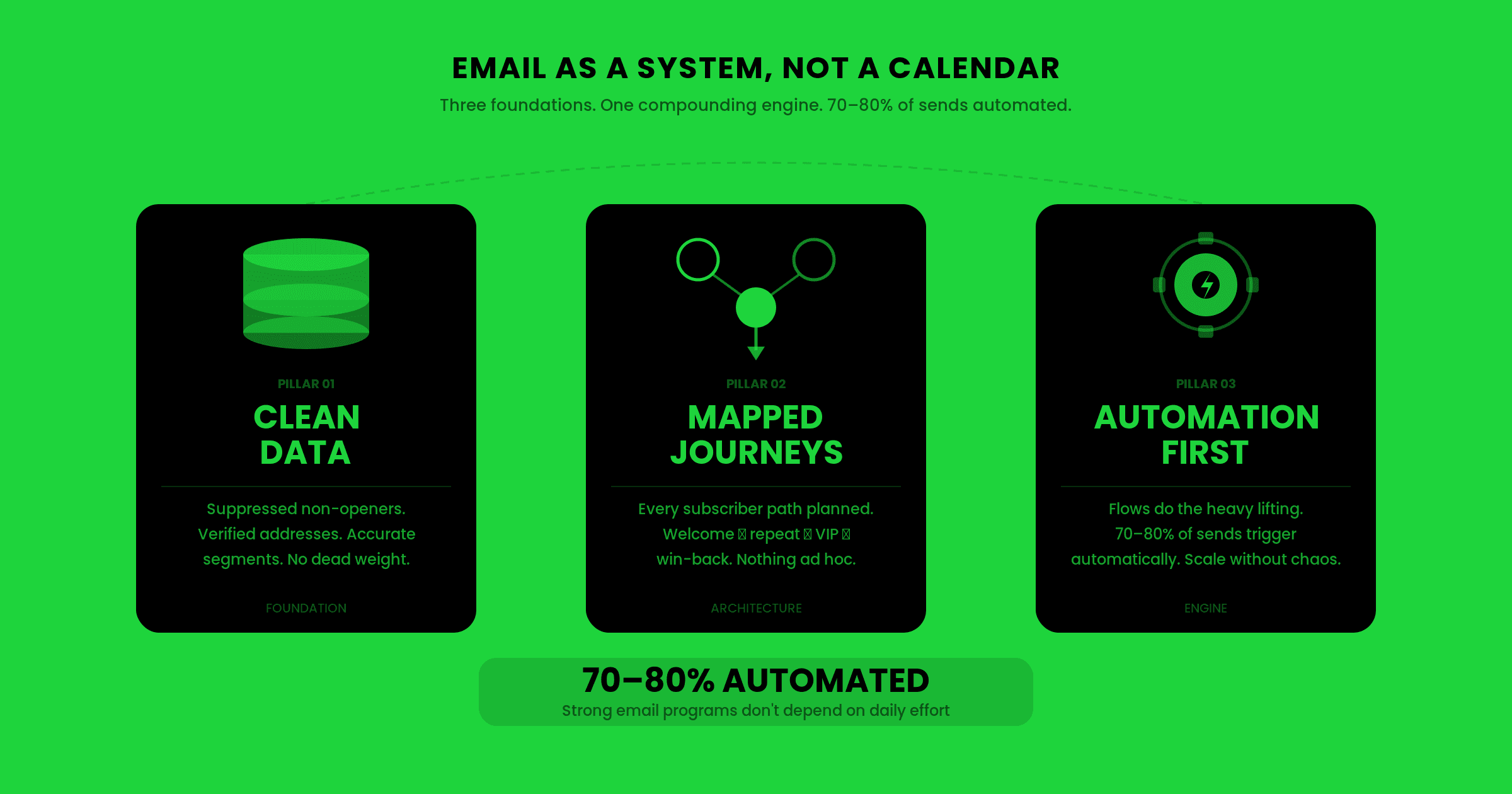
Klaviyo's default welcome series ships 3 emails. Top-decile brands run 5 to 7. Here's the sourced gap, the sequence, and the conditional split to build.
Klaviyo's public benchmarks put the average welcome flow at roughly $2.35 revenue per recipient ([source](https://www.klaviyo.com/blog/welcome-email-examples)). Top-decile brands on the same platform clear $21.18 RPR per Klaviyo's welcome-series benchmark table ([Klaviyo RPR explainer](https://www.klaviyo.com/blog/revenue-per-recipient)). That's a ~9× spread inside one flow type on one platform. The median and the top decile aren't running the same sequence. They can't be. If the 3-email default were pulling its weight, the gap wouldn't exist.
Here's what it is. The Klaviyo pre-built welcome series ships 3 emails over about a week ([Klaviyo Help, Welcome Series Setup](https://help.klaviyo.com/hc/en-us/articles/115002775172)). Most brands install it, name it "Welcome Flow," and walk away. The brands earning 7× more run 5 to 7 emails across 10 to 14 days, with a conditional split checking purchase behavior between every send. This guide walks the sequence, the split, and the metrics that matter. If you want the full architecture every flow in your account needs to share, read [the architecture guide for every flow you'll build](https://mailingmonk.com/blogs/email-automation-flows) first, then come back for the welcome-specific tactics.
## Why Klaviyo's default welcome series leaves money on the table
Three emails. Seven days. One discount. That's the starter kit, and it's the reason most welcome programs cap out fast.
Look at the spread again. Median welcome RPR lands near $2.35 per Klaviyo's own blog data ([source](https://www.klaviyo.com/blog/welcome-email-examples)). Top-decile programs land at $21.18 per Klaviyo's welcome-series benchmark table ([Klaviyo RPR explainer](https://www.klaviyo.com/blog/revenue-per-recipient)). The top decile isn't running secret creative. They're running more emails, spaced more deliberately, with rules between the sends. That's it. No magic.
Klaviyo itself ranks welcome as the second-highest-RPR flow in an e-commerce account, behind only abandoned cart ([Klaviyo RPR explainer](https://www.klaviyo.com/blog/revenue-per-recipient)). So this is a flow where the revenue is already reachable. The question is whether your sequence is long enough to reach it. Three emails in seven days gives a reader two chances to open, one chance to convert, then silence. Top-decile brands give that same reader five to seven chances to reengage, with a split stopping the flow the moment they buy. The math is loud.
One more tell. Agencies that publish their own sequences, including First Pier, FlowFixer, and Chase Dimond, all ship 4+ email sequences ([FlowFixer guide](https://www.flowfixer.com/blog/the-complete-guide-to-klaviyo-flows-for-ecommerce-2026), [Chase Dimond guide](https://www.chasedimond.com/klaviyo-flows-guide)). Not one of them agrees with the 3-email default. When the vendor says three and every agency says four or more, the SERP is telling you where the revenue sits.
## What a welcome series actually does (the job, not the tactic)
A welcome series has one job: convert a person who just raised their hand into a first-time buyer, before attention decays.
Signup is the peak of interest. Every hour after that is erosion. The sequence exists to deliver on the signup promise (usually a discount or a content bribe), set the brand expectation, hand off the objections, and give the buyer a calibrated reason to check out. That's the whole job. Not brand-building. Not newsletter seeding. Conversion inside a defined window.
Most failed welcome programs forget this and try to run a content magazine instead. The sequence ends up full of "founder stories," "press mentions," and "community highlights." That's what the newsletter is for. The welcome series is for closing the signup intent. Picture someone walking into a showroom, card in hand, and a salesperson reading them a company history for twenty minutes. They leave. The cart does too.
Your welcome flow's reader clicked subscribe because they wanted something specific. Deliver it. Then earn a second click.
One way to stress-test whether your current welcome flow is doing the job: pull the last 30 days of signups and check the placed-order rate inside that 14-day window specifically. If it's under 2%, the flow is running but it isn't converting. A flow that doesn't convert inside its defined window is a newsletter wearing a flow's costume. Rename it and keep looking for the real welcome.
## The 5-email sequence that converts (and when to extend to 7)
Here's the spine. Five emails, clear jobs, explicit timing. Extend to 7 when the product needs more education or the AOV needs more objection handling.
**Email 1. The promise (send: within 5 minutes of signup).**
Deliver the discount code or the lead magnet. Plain-text from a real person. No hero banner. No 4-column footer. Subject line bank: *"Your 10% is inside."* / *"Code's live, here's how to use it."* / *"One thing before you buy."*
**Email 2. The story (send: +24 hours).**
Founder letter. Why the brand exists, in 250 words, ending on a product the reader hasn't seen yet. This is the social-proof slot. Include one real customer quote and one product photo. No press logos unless the coverage is named and linked.
**Email 3. The product (send: +3 days).**
Bestsellers, collections, the sort readers are most likely to convert on. Optional: a conditional-split insertion point here (see next H2) that branches readers who've viewed a product page versus those who haven't.
**Email 4. The objection (send: +5 days).**
FAQ-as-content. Returns, shipping, sizing, sourcing, whatever the top three friction points are for your category. Treat it like a support page written as an email. This is where AOV brands lose readers who had a question and didn't get it answered on the PDP.
**Email 5. The window close (send: +7 days).**
Discount code expiration reminder. Single CTA. Short. Urgency without theater. "Code expires in 48 hours" works. "LAST CHANCE TO UNLOCK YOUR SAVINGS" does not.
Extend to 7 for brands with complex product ladders or >$150 AOV. **Email 6 at +10 days** covers category education (fit guides, ingredient explainers, use-case comparisons). **Email 7 at +14 days** is a final check-in with a re-qualification question ("still shopping, or should I send you something else?"). That question gives the sequence a graceful exit.
Signature line across all five: first-person, real name, reply-able address. Not `noreply@`. Never `noreply@`.
## Timing: why the first email goes out in 5 minutes, not 5 hours
Attention is perishable. A subscriber who gave you their email 4 minutes ago is a different person from the one who gave it to you this morning. The 4-minute version remembers what they were looking at when the popup hit.
Email marketer Chase Dimond reports that brands delaying the welcome email past the first hour see a meaningful conversion drop ([source](https://www.chasedimond.com/klaviyo-flows-guide)). Attribution: this is Dimond's claim from working accounts, not a peer-reviewed study. Directional and sourced, not law. Treat it as: the closer to signup, the better, with diminishing returns after the first hour.
Two Klaviyo-specific caveats. One, if you're using double opt-in, the 5-minute start begins at confirmation, not at the initial subscribe. Two, Apple's Mail Privacy Protection, live since 2021, preloads opens on a rolling schedule that makes open-rate timing look later than it really is. Don't tune your cadence to open-rate timestamps. Tune it to click and placed-order timestamps, which MPP doesn't touch.
Put another way: fire Email 1 fast. Then let the reader's actual behavior, not your calendar, drive the rest of the cadence.
## The conditional split that matters more than the emails
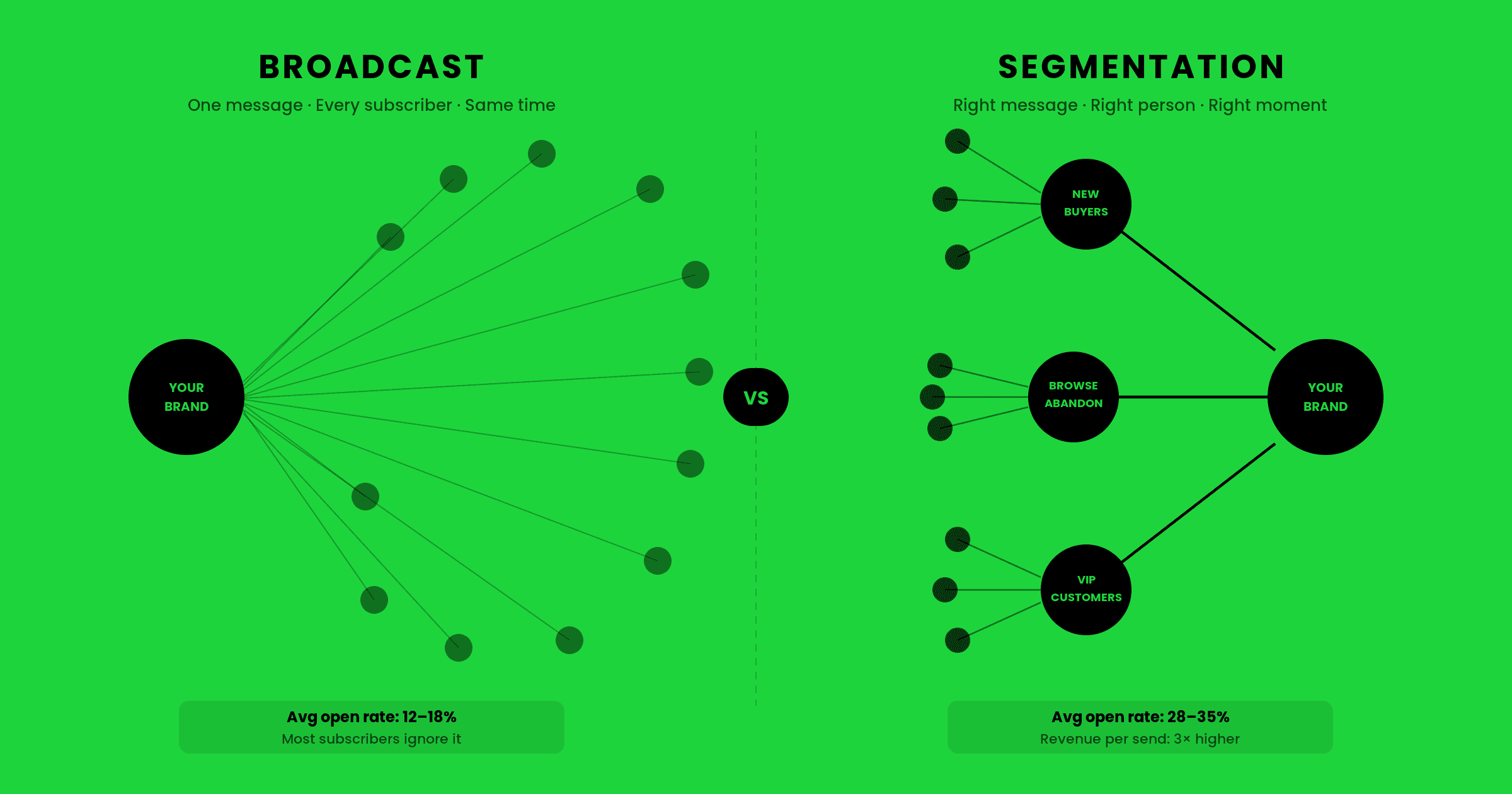
If you change one thing about your current welcome flow, change this. Put a conditional split between Email 3 and Email 4 that checks "Has Placed Order since starting this flow." If yes, end the flow quietly. If no, continue.
Klaviyo documents this filter pattern in its help center ([source](https://help.klaviyo.com/hc/en-us/articles/115002775172)). Most accounts use it as a flow-level filter at the top of the sequence, which catches people who'd already bought before joining the list. Fewer accounts use it as a mid-flow split, which is where the real save happens. A reader who bought off Email 2 should not get the objection-handling email on day 5. They should definitely not get the discount-expiration reminder on day 7. Both send a signal that your automation doesn't know what your checkout already told it. Small insult, real churn consequence.
Three concrete splits to build:
1. **Pre-flow filter.** "Has Placed Order at least once over all time = FALSE." Catches customers who already bought and shouldn't receive a welcome-discount bribe at all.
2. **Mid-flow split after Email 2.** "Has Placed Order since starting this flow = TRUE" ends the flow. FALSE continues to Email 3.
3. **Mid-flow split after Email 4.** Same logic. Last chance to stop the sequence before the urgency email fires on someone who already converted.
If you're thinking through how these splits interact with segments you're already running, the [segmentation hub (coming soon)](/blogs/segmentation-hub-placeholder) covers the behavior-based segment logic that pairs with welcome splits.
A few edge cases the splits have to handle gracefully. First: repeat subscribers. Someone unsubscribes, resubscribes three months later, and the flow fires again. Your pre-flow filter should check "Has Placed Order in the last 90 days = FALSE" rather than "Has Placed Order at least once over all time = FALSE" if repeat customers are a meaningful share of your list. Second: multi-product purchasers. If a reader buys a $15 accessory off Email 2, they probably still want the Email 4 objection content for the $180 main product. In that case, split on revenue-threshold, not on event. Third: list-to-list migrations. Readers who join via a popup versus a checkout versus a giveaway arrive with different intent. Consider branching Email 1 by list source if the difference in behavior is visible in your data. Klaviyo's conditional-split node handles all three patterns natively.
Running welcome logic without any of these splits is the most expensive mistake in the account. We see it weekly in retention audits. If a second set of eyes on your flow architecture would help, the [retention audit](https://mailingmonk.com/pricing) is built for exactly this check.
## Discount strategy without discount dependence
Welcome discounts work. Welcome discount addiction doesn't. Here's the difference.
Front-load the discount in Email 1. Time-box it explicitly. Remind once in Email 5 when it's about to expire. Stop.
The failure mode is subtler than you'd think. Discount-heavy welcome series often cap around 2% placed-order rate ([Klaviyo blog, 1.97% industry figure](https://www.klaviyo.com/blog/welcome-email-examples)), because the reader learns that the discount is the relationship. Every future email has to match or beat that offer to get a click. You've just built a customer who converts on price and churns on price. That's a CAC problem pretending to be a retention strategy.
A better shape: the discount is the anchor for Email 1 and Email 5 only. Emails 2, 3, and 4 sell on product, story, and objection-handling. When the discount expires, the reader has seen three non-discount reasons to come back. Now you've taught them that your brand is the relationship and the discount was a courtesy. Different customer. Different LTV.
One rule that catches most accounts: the conditional split from the previous H2 must suppress the expiration reminder for anyone who already converted. Sending "your discount is about to expire" to someone who used it yesterday is the kind of detail that reads as amateur.
## The architecture is portable (Klaviyo is not the moat)
Everything above is Klaviyo-native. List trigger, conditional split, time delay, placed-order filter. The same primitives exist in ActiveCampaign automations, Brevo automation workflows, HubSpot workflows, Mailchimp Customer Journeys, and Omnisend automation. The UI is different. The logic isn't. If you're not on Klaviyo, map "list trigger" to "signup event," "conditional split" to "if/then branch," and "time delay" to "wait step." Every other rule in this guide still works.
The tool is not the strategy. The sequence is the strategy.
## Metrics: what to watch, what to ignore
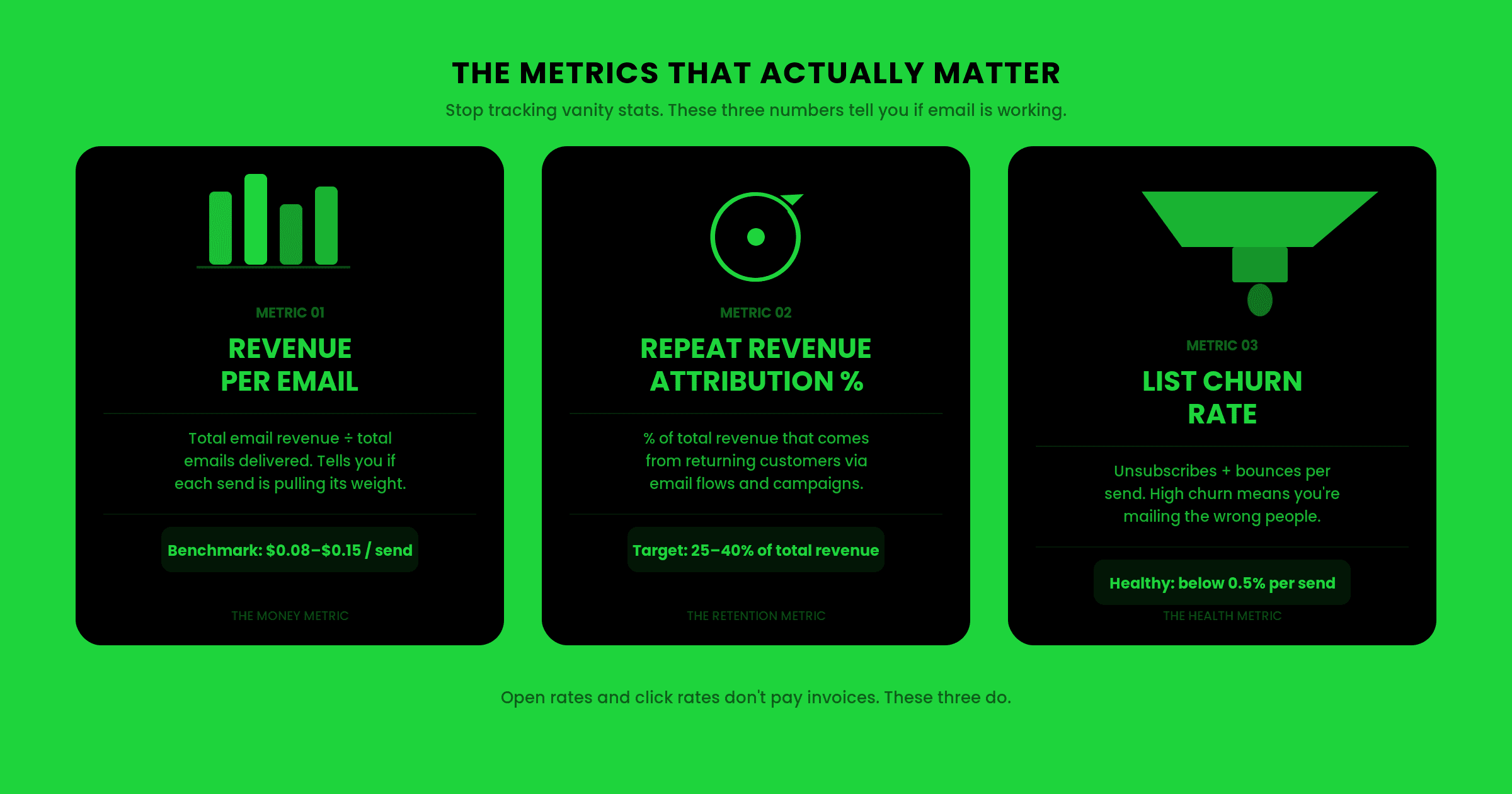
Watch two numbers. Placed-order rate and revenue per recipient. Those are the flow-level metrics that tell you whether the sequence is doing its job.
Open rate was useful through mid-2021. Apple's MPP inflates it now. Directionally useful, not load-bearing. Click rate still means something, because clicks require intent MPP can't fake. So the watch order, in priority: **placed-order rate → revenue per recipient → click rate → open rate (directional only)**.
Klaviyo's flow benchmarks put welcome-email open rates in the 45% to 50% range ([Klaviyo Help, Flow Benchmarks](https://help.klaviyo.com/hc/en-us/articles/360033669452)), which sounds impressive. It is, with the MPP caveat. Use it as a deliverability check (if your welcome opens fall below 30%, you have an inboxing problem, not a creative problem), not as a conversion signal.
Revenue per recipient is the one metric that ties effort to outcome cleanly. $2.35 is the rough median per Klaviyo ([source](https://www.klaviyo.com/blog/welcome-email-examples)). $21.18 is top-decile per Klaviyo's welcome-series benchmark table ([RPR explainer](https://www.klaviyo.com/blog/revenue-per-recipient)). If your welcome RPR is under $3, the sequence is the problem before the creative is the problem. Lengthen before you redesign. Same applies to [abandoned cart flow (coming soon)](/blogs/klaviyo-abandoned-cart-flow-placeholder) optimization work: architecture first, creative second.
One final benchmark for context: flows generate roughly 41% of total email revenue from about 5.3% of sends across e-commerce ([Klaviyo Ecommerce Benchmarks](https://www.klaviyo.com/marketing-resources/ecommerce-benchmarks)). Welcome is a top-three contributor inside that 41%. This is where the retention money hides.
## The 3 most expensive welcome-series mistakes we see
Three failures show up in almost every welcome-flow audit. Any one of them caps the RPR. Combined, they're the reason the median brand sits near $2.35.
**Mistake 1. Running the Klaviyo default past the training-wheels stage.** The 3-email pre-built flow is fine for a brand with a 500-subscriber list and one SKU. For a brand with real signup volume and a product ladder, it's a RPR ceiling. The fix is the 5-to-7-email sequence above. No creative miracle required.
**Mistake 2. No conditional split on purchase behavior.** Readers who buy off Email 2 get the full discount-nag sequence anyway. Every send after the purchase is a small tax on brand trust. Over 90 days, those taxes compound. The fix is the three splits from the conditional-splits section: pre-flow filter, post-Email-2 split, post-Email-4 split.
**Mistake 3. Designed-from-scratch HTML for Email 1.** The first email in the sequence is a transactional-feeling handoff. Plain-text from a real person beats full-template HTML in most accounts Chase Dimond has published on ([source](https://www.chasedimond.com/klaviyo-flows-guide)). Attribution matters here: this is an agency claim, not a universal law, and your account should A/B it. Start with plain-text as the control. Design variants earn their slot by beating it.
Three fixes. Each one independently lifts RPR. Combined, they're why the top decile isn't the top decile by accident.
## FAQ: what people ask about Klaviyo welcome series
**How many emails should a Klaviyo welcome series have?**
Five to seven, not three. Klaviyo's pre-built template ships three, and that's the reason the median welcome RPR is near $2.35 while top-decile brands clear $21.18 per Klaviyo's welcome-series benchmark table. The extra emails give readers more reengagement chances and let you split on purchase behavior between sends. See the 5-email spine in [the flows pillar](https://mailingmonk.com/blogs/email-automation-flows) for how this fits with your other automated sequences.
**How long should a Klaviyo welcome series be?**
10 to 14 days across 5 to 7 emails. Email 1 fires within 5 minutes of signup. Email 2 lands 24 hours later. After that, 2-to-3-day gaps through Email 5, and 3-to-4-day gaps if you extend to 6 or 7. The window is bounded by attention decay. Past 14 days, a subscriber who hasn't opened is telling you they aren't buying from this flow.
**What should each email in a welcome series say?**
Email 1 delivers the promise (the discount code or lead magnet). Email 2 is the founder/brand story. Email 3 surfaces the products. Email 4 handles objections (FAQ-as-content). Email 5 closes the discount window with urgency. If you extend to 7, Email 6 is category education and Email 7 is a re-qualification check-in. See the full breakdown in the "5-email sequence" section above.
**How much revenue does a Klaviyo welcome series generate?**
Median welcome RPR across e-commerce is roughly $2.35 per Klaviyo's public blog data. Top-decile brands report $21.18 RPR per Klaviyo's welcome-series benchmark table. Welcome is the second-highest-RPR flow in a typical account, behind only abandoned cart. A 1.97% placed-order rate is the published industry-aggregate figure for welcome emails specifically. Your number will depend on AOV, list quality, and cadence, but those are the anchors to benchmark against.
**Where does that leave you?** If your welcome flow is three emails, your placed-order rate is under 2%, or your RPR is under $3, the sequence is capping your revenue before the creative even has a chance. Lengthening to 5 or 7 emails and adding the conditional split usually moves the number within the first 30 days. If you want a second set of eyes on the flow before rebuilding, [what working with Mailing Monk looks like](https://mailingmonk.com/pricing) is a retention audit. Sixty minutes, flat fee. We tell you what's broken and what we'd rebuild first. Then you decide whether we're the right team to rebuild it, or whether your in-house team runs with the plan. Either way, you walk out with a map.
Welcome flows are one piece of the retention stack. Cart, browse, post-purchase, and win-back all share the same architecture logic. If you want the full picture before you touch the welcome series, the [architecture guide for every flow you'll build](https://mailingmonk.com/blogs/email-automation-flows) is the place to start.
Our mission is simple: help brands grow through better emails. We focus on strategy, design, and data to turn the inbox into a high-performing sales channel; without the noise. We believe great email marketing is clear, personal, and built to last.