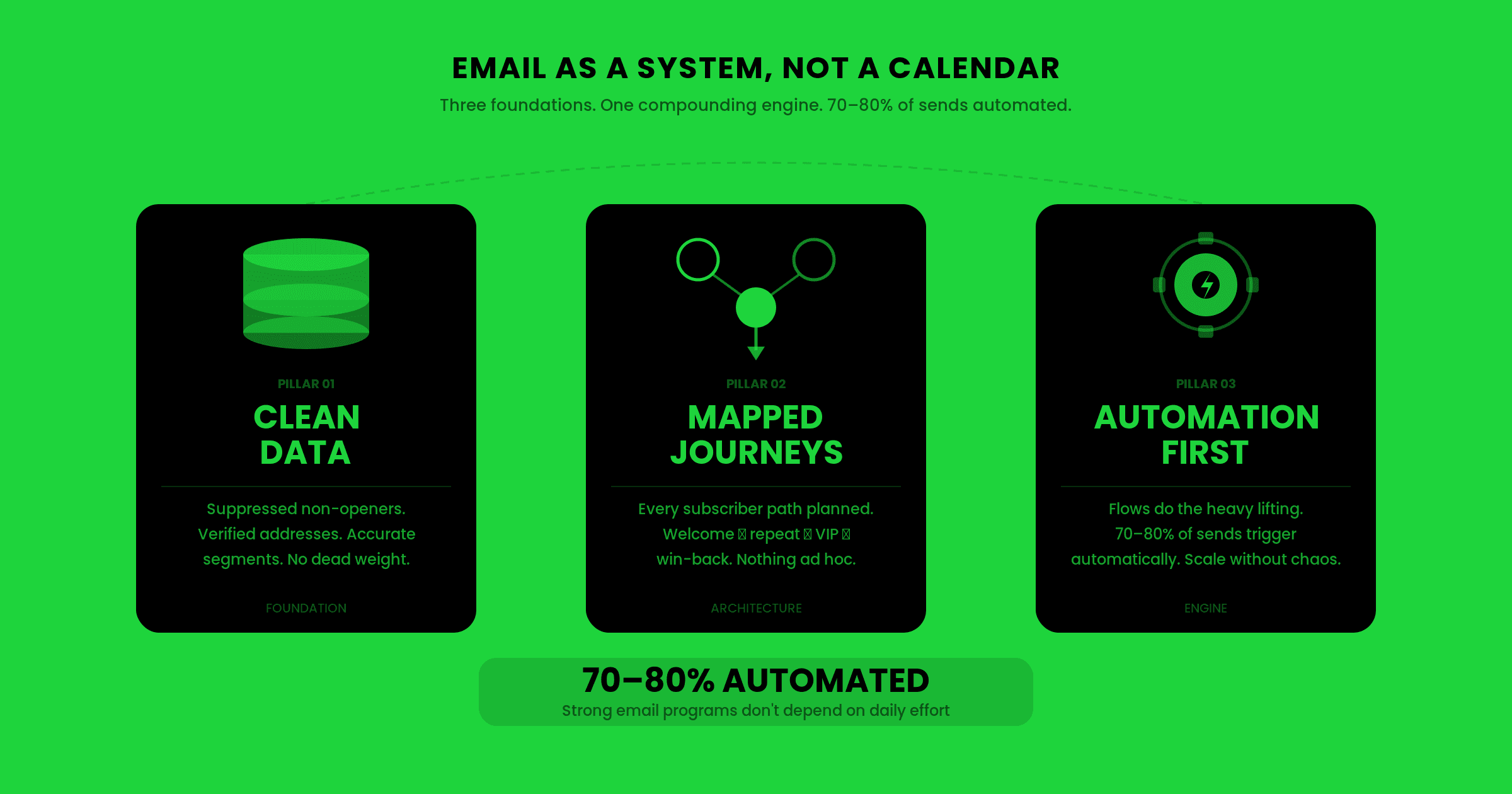
Email automation flows produce 41% of email revenue from 5.3% of sends. Most brands underbuild the wrong flow. We run them flat at $1,500/month.
Automated flows produce roughly 41% of email revenue from about 5.3% of total sends, per Klaviyo's 2026 Omnichannel Benchmark Report. Most businesses spent the last two years tuning the other 94.7%. That's the gap this post is about.
If you run a DTC store, a B2B SaaS company, a subscription brand, an info product, an agency, or anything in between with an active email list, your flows are doing more of the work than your campaigns, and you probably haven't rebuilt them since launch. We've audited enough accounts on enough platforms to know the pattern. The leak is structural. It's the same leak whether you're on Klaviyo, Mailchimp, ActiveCampaign, HubSpot, or Omnisend, because every one of those tools implements the same primitives under different names.
Here's what the next five thousand words give you. A flow-by-flow walkthrough grounded in 2026 benchmarks. A stated opinion about which flow most teams underbuild. A platform-neutral architecture so the lessons port to whatever tool you're already paying for. We charge $1,500 a month flat to do this for a living. The post tells you what we'd do anyway.
The campaign-versus-flow debate is over. The numbers ended it.
One caveat up front. If your business doesn't have an email list yet, this post isn't for you. Build the list first. Come back when you have at least two thousand subscribers and an offer that actually converts cold traffic. Flows compound on top of a functioning acquisition engine. Without subscribers, there's nothing to flow to, and the best welcome sequence in the world gets sent to an empty room. Build the list, then come back. Everything below assumes you're already past that step.
Now the numbers.
Across the largest publicly-published flow benchmark dataset, automated flows generate about 41% of total email revenue from about 5.3% of total sends. Revenue per recipient runs roughly 18 times higher than one-off campaigns. Click rates hit 5.58% against 1.69% for campaigns, a 3 times gap. Placed-order rates run 13 times higher. All of that is from the Klaviyo 2026 Omnichannel Benchmark Report, the same report cited at the top of this post. A representative cross-platform synthesis, referenced in Geysera's 2026 cross-vendor analysis at geysera.com, puts automated flows at roughly $1.94 revenue per recipient against $0.11 for campaigns, about an 18 times gap.
That's an enormous concentration. Five percent of your sends doing forty percent of your work.
The vendors corroborate. Mailchimp reports that abandoned cart emails generate an average of 34 times more orders than bulk email alone, based on their current product page self-report. Per Omnisend's 2025 email marketing report, automated emails earned $2.87 per email sent against $0.18 for scheduled campaigns, about 16 times more revenue per send, despite automations making up only 2% of total volume and driving 30% of revenue. The numbers move with the methodology. Klaviyo's last-click 5-day window isn't Mailchimp's reporting model, and neither is Omnisend's. But the rank order is identical across publishers. Cart beats welcome beats broadcast. Always.
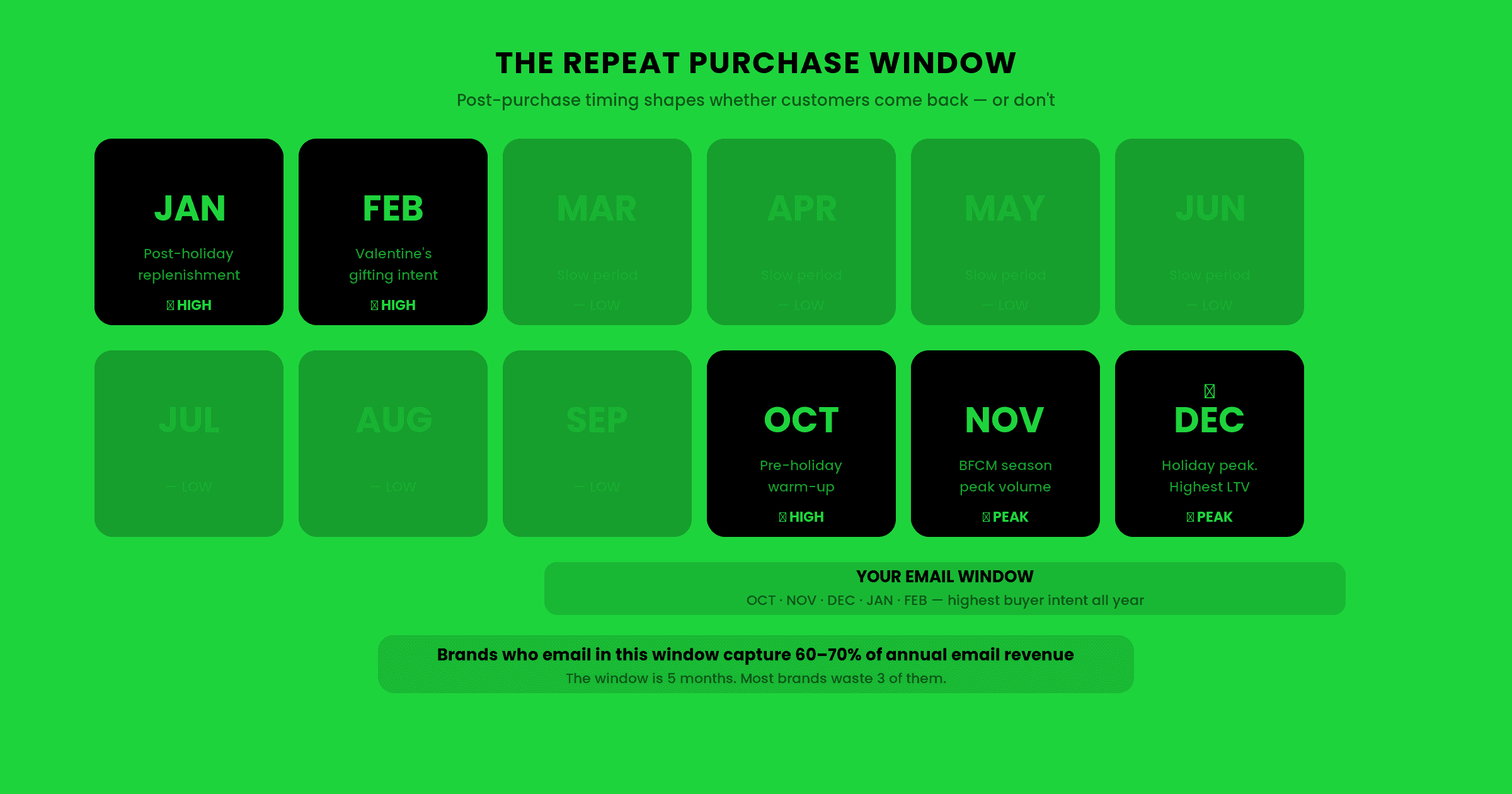
Layer the macro on top. Email marketing has averaged a $36 to $42 return per $1 spent across recent industry studies (DMA, 2020; Litmus, 2022), published in Litmus' ROI infographic. Bain and Company and Harvard Business School research, originally Bain 1990 and recirculated by Shopify's customer-retention article, found that a 5% increase in customer retention can boost profits by 25% to 95%. Flows are the single biggest retention lever email gives you.
The takeaway is unromantic. If your team spends a Tuesday building a clever campaign and a Friday optimizing the welcome flow, you've inverted the leverage ratio. The Friday work is worth multiples of the Tuesday work. We tell every prospect the same thing. Stop tuning campaigns until your flows are right.
The flow most businesses underbuild is the one we'd build first.
Here's the opinion. Most businesses obsess over the abandoned cart flow because it's the highest-revenue flow on paper. They're optimizing the wrong flow. The welcome flow is the highest-leverage flow most brands underbuild, and it should be 7 emails over 14 days, not the default 3 most platforms ship with.
The data backs it. The welcome flow's average revenue per recipient is $2.65 across the Klaviyo 2026 Email Marketing Benchmarks. Top-10% Klaviyo merchants average $21.18 per recipient. That's an 8 times gap between average and top-decile performance. Compare to the abandoned cart flow, where the average placed-order rate is 3.33% and the top-10% rate is 7.69%, per the Klaviyo Abandoned Cart Benchmark Report, 2024, based on 143K abandoned-cart flows sent in 2023 via last-click attribution with a 5-day window. That's a 2.3 times gap. The welcome flow has roughly four times the headroom.
Two more reasons.
A subscriber enters the welcome flow exactly once. You either capture the relationship in the first 14 days or you spend the next six months trying to re-warm a cold contact. Abandoned cart, by contrast, can re-trigger every time the same person abandons. It's a recovery floor, not a growth ceiling.
And recovery flows have a structural ceiling that nurture flows don't. Average ecommerce cart abandonment hovers at 70.22% per the Baymard Institute's current compilation across 50 studies spanning 2006 to 2025, with a range from 55.00% to 84.27%. That's roughly the leak rate the abandoned cart flow is fighting against. The welcome flow isn't bounded by a fixed industry leak rate. It's bounded by how good the sequence is. Headroom is unlimited.
Most welcome flows we audit are three emails. Discount handoff. Brand story. Nudge. Done. The brands that earn the $21.18 per recipient number build seven to nine emails over 14 days that branch by source, meaning paid social versus organic versus referral, branch by quiz answer, meaning skin type, fit, use case, and progressively reveal product, social proof, founder story, and risk-reversal language. It's a sequence, not a coupon delivery service.
If you happen to be on Klaviyo specifically, here's the 7-email welcome series we ship, with the conditional split logic and timing. The architecture is the same on every other platform. The UI is the only thing that changes.
The abandoned cart flow, done correctly across every platform.
Abandoned cart is the highest-revenue flow on the average dashboard for a good reason. Average placed-order rate is 3.33%. Top-10% performers hit 7.69%. Average revenue per recipient is $3.65, the highest of any flow type, per the same Klaviyo Abandoned Cart Benchmark Report cited above. Mailchimp and Omnisend's published numbers point the same direction. Mailchimp's 34 times orders multiplier. Omnisend's aggregate automation-over-campaign gap of 16 times per send. Different attribution models, identical pattern.
The number-one mistake we see, across every platform, isn't copy or timing. It's the trigger.
The default abandoned cart trigger on most platforms fires on the equivalent of "Started Checkout." Klaviyo's default is the Started Checkout metric. Mailchimp, ActiveCampaign, HubSpot, and Omnisend each have their own naming, but the architectural mistake is identical. The trigger excludes everyone who added an item to cart but never reached the checkout page. That's the largest segment in your funnel, and it's getting nothing.
The fix is to layer triggers. Use Added to Cart as the upstream trigger, which catches everyone who showed buying intent, then condition the flow path on whether they reached checkout. The cart-only branch gets a softer reminder. The checkout-abandoner branch gets the urgency-and-discount sequence. Same architecture, different pressure.
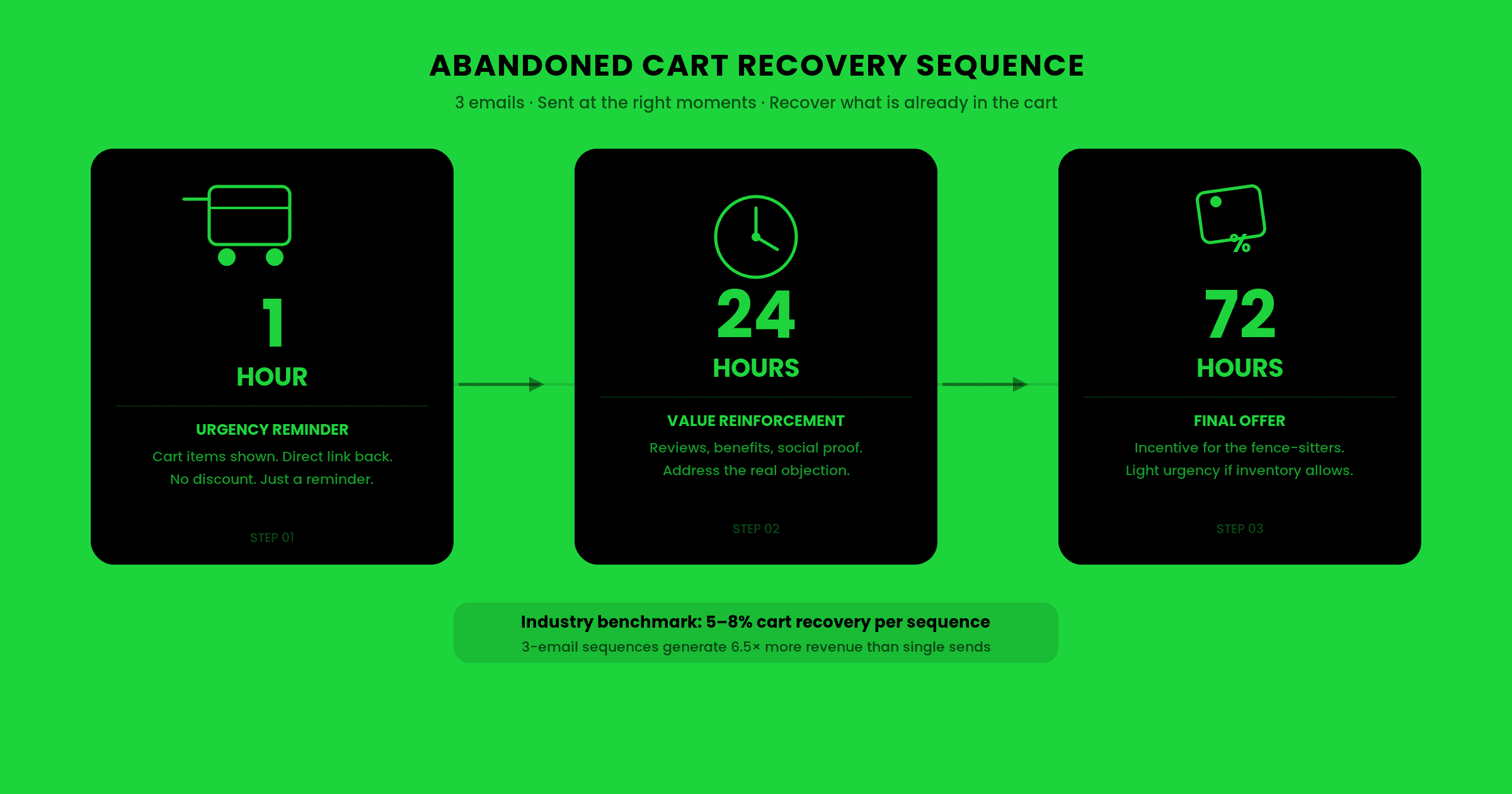
Timing next. The default sequence on most platforms is some variation of 1 hour, then 24 hours, then 72 hours. We run 15 minutes, then 1 hour, then 24 hours, then 72 hours. The 15-minute send is the highest-converting email in the sequence for most stores. The cart's still warm. The buyer's still on their phone. The friction was usually a payment or shipping question that a one-paragraph email resolves. Most teams don't send it because the platform's setup wizard doesn't suggest it.
Exit conditions matter. The flow should exit on Placed Order, which is obvious, on a fresh Started Checkout, meaning they came back on their own, and on a hard unsubscribe, which is the consent guardrail. Flows that don't exit cleanly send recovery emails to people who already bought. That's the fastest way to teach your audience to ignore your sender name.
For the Klaviyo-specific build, including the segment definitions and the conditional split tree, see the abandoned cart flow built out for Klaviyo specifically. The same architecture maps onto ActiveCampaign automations, HubSpot workflows, Mailchimp's customer journey builder, and Omnisend workflows with minor name changes and identical logic.
Post-purchase is a retention play. Stop measuring it like a conversion play.
The post-purchase flow has the lowest placed-order rate of any major flow, 0.54% on average per Klaviyo's published benchmarks. Most teams look at that number and deprioritize the flow. They're reading the wrong metric.
Post-purchase messages see roughly 217% higher open rate, 500% higher click-through rate, and 90% higher revenue per recipient than the average email campaign, per Klaviyo's 2024 analysis at klaviyo.com/blog/5-steps-to-improve-placed-order-rate. Buyers who just bought are the most engaged audience you'll ever have. The flow's job isn't to convert them on the next email. It's to set up the second purchase.
Reframe the success metric. Don't measure post-purchase on the placed-order rate of any single message. Measure on second-order rate over 60 and 90 days against a control group that didn't get the flow. That's the number that matters. And it's the number that ties back to Bain's retention math. A 5% increase in customer retention can boost profits by 25% to 95%.
The sequence we run, in order:
First, order confirmation. This is transactional, owned by the platform, but customizable in Klaviyo, ActiveCampaign, HubSpot, and others. Make it brand-voice, not corporate. Second, shipping confirmation. Third, a use-the-product email two days after estimated delivery. The content depends on product type. For consumables, it's "here's how to get the most out of it." For apparel, it's "here's how to style it." Fourth, a review request seven to ten days after delivery. Fifth, a cross-sell or replenishment trigger conditioned on product category and average days-between-purchase from your actual order data.
The product-education email is the one most teams skip. It's the highest-leverage email in the sequence because it lifts CSAT, lifts review submission rate, lifts second-order rate, and reduces support volume. We've never built a post-purchase sequence and not seen the third email outperform the second.
For the Klaviyo-specific deep dive, including the cross-sell logic that uses Predictive Insights, see the post-purchase sequence we use to lift second-order rate, in Klaviyo. The same architecture exists in HubSpot workflows, using workflow goals as the conversion gate, ActiveCampaign automations with conditional waits, Mailchimp customer journey, and Omnisend workflows. Different UI primitives, identical behavior.
Browse abandonment is a top-of-funnel touch. It's not a recovery flow.
Browse abandonment gets stuck in the recovery bucket because it sounds like cart abandonment. Different intent. Different metric. Different job.
The numbers tell the story. Browse abandonment's average placed-order rate is 0.95%, about a third of cart-abandon's rate. Average revenue per recipient runs around $1.07. But the open rate is in the 30% to 35% range, higher than abandoned cart's open rate. Engagement is up. Conversion is down. All from the same Klaviyo 2026 Email Marketing Benchmarks dataset.
The reason is intent. A cart abandoner picked a product, picked a size, picked a quantity, and stopped at the checkout page. They're 80% of the way to a purchase. A browse abandoner clicked a product page and left. They might be researching. They might be price-shopping. They might be on a phone in line at Starbucks. The buying signal is faint.
So the success metric for browse abandonment isn't direct attribution. It's assist. Did this email push the visitor back into the consideration set so the next campaign converts them? Did it surface a product they'd already shown faint interest in, so the next time you send a broadcast, that product carries pre-warmed familiarity?
Tactically, we run two browse abandonment emails. One at four hours, image-led, "still thinking?" One at 48 hours, review-led, social proof on the same product. Exit conditions are the same as cart abandonment plus an exit on Browse to a different category, because if they moved on, the email's irrelevant.
Browse abandonment is also the flow where MPP-driven open-rate inflation hurts most. Apple Mail Privacy Protection prefetches images, which auto-marks emails as "opened." Open-rate as a success metric on this flow is increasingly fictional. Measure on click rate plus assisted attribution, not opens.
Win-back and sunset flows. When to fire someone from your list.
Most teams run a 180-day win-back flow because that's what the platform setup wizard suggests. It's the wrong number for most stores. The right number is roughly 1.5 times your average days between repurchases, which means you have to look at your actual purchase data, not the platform default.
If your average customer reorders every 60 days, which is typical for consumables, supplements, or replenishables, your win-back trigger should fire around day 90, not day 180. By day 180 the customer's already replaced you. If your average customer reorders every 240 days, which is typical for apparel, durable goods, and considered purchases, then 180 days is too early. You're sending re-engagement to people who'd come back on their own at day 220.
The math works the same on every platform. Klaviyo, Mailchimp, ActiveCampaign, HubSpot, and Omnisend all let you compute average days-between-orders per customer cohort. None of them set this trigger correctly by default because none of them know your repurchase cycle.
The win-back sequence itself we run as four emails over 14 days. Subtle nudge, meaning "we've missed you." Value-driven, meaning "here's what you missed." Incentive, meaning "we'd like to bring you back, here's 15%." Break-up, meaning "if we don't hear back, we'll stop emailing you." The break-up email is the highest-converting email in the sequence for most stores. People reply to ultimatums.
If win-back fails, sunset. The sunset flow is list hygiene as a deliverability investment. Anyone who hasn't opened or clicked in 90 days post-win-back gets removed from active sending and moved to a suppression list. That hurts in the moment, because your active list shrinks. It pays in inbox placement, because mailbox providers reward sender lists with high engagement rates.
You can't out-flow bad deliverability. Sunset is the flow that protects every other flow. It's also the flow most teams skip because watching the active subscriber count drop feels like losing.
Replenishment, VIP, birthday, and quiz flows that compound over twelve months.
Beyond the core six, there's a tier of flows that don't anchor a quarter on their own but compound across a year. We build them last. We never skip them.
Replenishment flow, for consumable products. Trigger on time after purchase, set per product to roughly 80% of the product's expected use cycle. A worked example. A customer bought a 30-day supplement supply on January 1. The replenishment trigger fires on January 24, suggesting reorder before they run out. A customer bought a 90-day skincare bottle on March 1. The replenishment fires on May 22. The math is identical across product categories. Only the interval changes. The cleanest native implementation lives in HubSpot workflows and Klaviyo, both of which read product-level metadata at the profile level. ActiveCampaign and Omnisend can do it with custom event tracking. Mailchimp's customer journey builder can do it with a tagged-list architecture. More setup, identical outcome. We've seen replenishment flows alone deliver 3% to 7% of total email revenue within six months of launch for brands with genuinely consumable products.
VIP flow. Identify your top-customer segment, whether top 5% by lifetime value or top 10% by repeat purchase count, pick one definition and document it, then give them lighter, higher-touch communication. Early access to launches. Personal-feeling subject lines from the founder. Surprise rewards on milestones like fifth order, first anniversary of signup, or lifetime value threshold crossings at $500 or $1,000. The VIP flow is one of the few places where platform UI genuinely matters. Predictive customer-lifetime-value scoring is built into Klaviyo Predictive Insights and HubSpot AI tools natively. ActiveCampaign, Mailchimp, and Omnisend require you to compute the LTV segment yourself and feed it back. Same outcome, more work.
Birthday and anniversary flows. Lightweight, high-engagement, low-revenue per send but high cumulative goodwill. A typical birthday flow fires 7 days before the subscriber's birthday with a low-pressure gift offer, then a reminder on the day itself if unopened. Anniversary flows fire on the signup date each year. Neither is load-bearing revenue. Both earn replies. Reply behavior teaches mailbox providers your sender is wanted in the inbox, which compounds into better inbox placement across every other flow. That second-order effect is the real reason we build them.
Quiz-funnel flows. If you run a product quiz on your site, the quiz-completion flow is one of the highest-converting top-of-funnel sequences possible. The buyer self-segmented by answering the quiz. You know exactly which product fits their skin type, their body type, their use case. The follow-up sequence converts at multiples of the cold welcome flow, often two to four times, because the segmentation is borrowed from the buyer's own answers rather than inferred from behavior. Most brands launch the quiz, collect the email, show a results page, and then forget to wire the post-quiz email sequence. They wonder why their welcome flow underperforms when a third of their signups came through a quiz that told them everything about the buyer and got ignored downstream.
Back-in-stock and price-drop triggers. Two more flows worth naming. Back-in-stock fires when a product the subscriber viewed or wishlisted comes back into inventory. Price-drop fires when a viewed product drops a set percentage. Both are low-volume but high-conversion, because the trigger itself is already the buying signal. Every major platform supports them. Almost nobody configures them correctly.
These flows compound. The first month they don't move the needle much. By month twelve, they're 8% to 15% of total flow revenue without a single new build, simply because the subscriber base has grown into them. That's the architecture earning interest.
Triggers, splits, and timing. The mechanics under the platform UI.
This is the section where the platform-neutral architecture lands hardest.
Every major email platform implements the same flow primitives, including triggers, conditions, time delays, and splits, under different names. Klaviyo calls them "flow actions." ActiveCampaign calls them "automation steps." HubSpot calls them "workflow actions." Mailchimp calls them "journey steps." Omnisend calls them "workflow steps." The architecture is the same. The UI isn't.
The four primitives that matter.
Triggers. What event starts the flow. Event-based, meaning Placed Order, Added to Cart, Started Checkout. List-based, meaning joined list, joined segment. Date-based, meaning anniversary of signup, birthday, days since last order. Behavior-based, meaning clicked email, viewed page N times. Most platforms support all four. The trigger choice usually determines the flow's conversion ceiling. Pick the wrong one and you're catching the wrong audience for the rest of the flow's life.
Conditional splits. "If condition X is true, go down path A, otherwise path B." Used for branching by source, by purchase history, by product category, by VIP status, by anything in your customer profile. Klaviyo's conditional splits are particularly UI-friendly. HubSpot's workflow if/then branches read closer to a developer's flowchart. ActiveCampaign's conditional content goes deeper but takes longer to debug. Same outcome, different ergonomics.
Time delays. The wait between emails. The most under-used primitive. Most flows we audit have time delays set to round numbers like 1 day, 2 days, 3 days, because the platform's setup wizard suggested them. Optimal time delays are derived from your actual data. When do your buyers convert relative to the trigger event? Almost never on round numbers. Try 18 hours instead of 24. Try 4 days instead of 3. Try 90 minutes instead of 2 hours.
Exit conditions. When the flow stops sending to a given subscriber. Often missing entirely in flows we audit. Without clean exit conditions, you're sending recovery emails to people who already bought. That's the fastest unsubscribe lever in email marketing.
A/B test splits are a fifth primitive worth knowing. Every major platform supports them on a flow level, and you should run one continuously on the highest-volume flow you have. Subject line tests on welcome email #1. Send-time tests on the cart-abandon 24-hour email. Anything else is leaving money on the dashboard.
If your flows skip any of these primitives, you're operating below the platform's capability. Most do.
Designing flows around 2026 capabilities, not 2019 capabilities.
Three things changed since the last time most teams touched their flows. If your architecture predates these, it's leaking.
Predictive scoring is now a flow primitive on the major platforms. This is the biggest shift, so it's worth walking through with a real example.
Klaviyo Predictive Insights surfaces four predictions at the profile level. Predicted customer lifetime value. Expected next-order date. Churn risk score. Predicted gender. HubSpot's AI tools score leads by likelihood-to-close and surface predicted deal size. ActiveCampaign offers predictive sending, which picks the optimal send time per subscriber based on historical open behavior, and predictive content, which selects the best-performing variant per recipient. Mailchimp and Omnisend are adding similar capabilities through their AI features.
None of these were available the last time most welcome and post-purchase flows were architected. They turn flows from time-based into intent-based. Consider a concrete example. A time-based welcome flow sends email #3 on day 3, email #4 on day 5, and email #6 on day 10, to everyone. A predictive-scoring welcome flow splits the same sequence by predicted CLV at signup. High-predicted-CLV subscribers get a compressed 5-email sequence over 7 days because they're ready to buy. Low-predicted-CLV subscribers get a longer 9-email sequence over 21 days, weighted toward brand story and education, because they need more trust-building before conversion. Medium-predicted-CLV subscribers get the standard 7-email sequence. Same creative assets. Three different shapes of flow. The high-CLV cohort converts faster. The low-CLV cohort converts at all, instead of unsubscribing mid-sequence because they weren't ready.
The same logic applies to post-purchase. A churn-risk-weighted post-purchase flow sends the VIP-style retention sequence to buyers flagged as high churn-risk and the default lighter sequence to everyone else. Expected-next-order-date feeds the replenishment trigger directly, replacing the static 80% time-math with a dynamic per-subscriber prediction. Every platform supporting predictive scoring lets you architect this way. Almost no agencies do, because the flow builds are more work and the ROI shows up 90 days out.
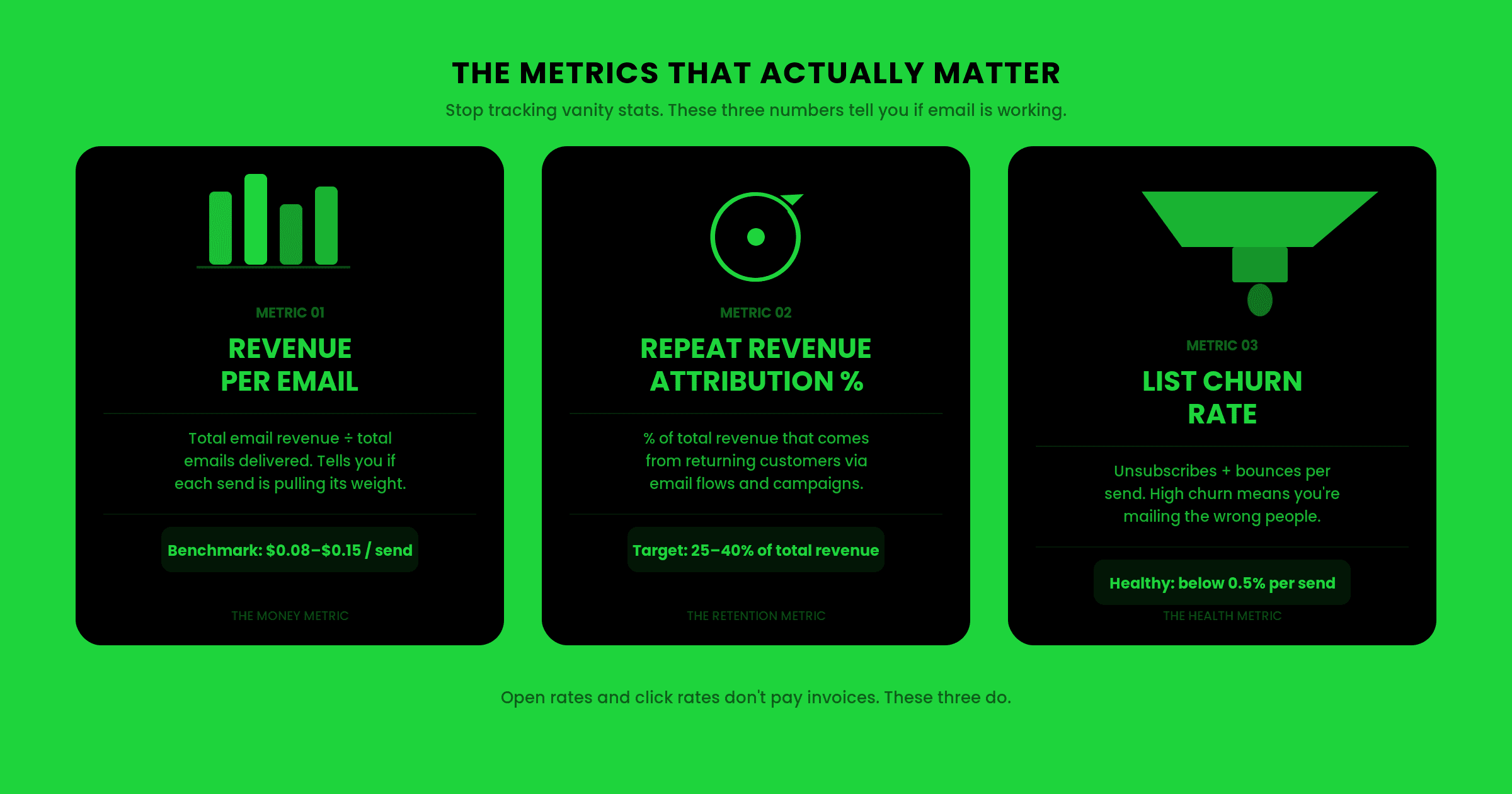
MPP-aware metrics. Apple Mail Privacy Protection has been live since iOS 15, released in 2021. MPP prefetches images, which auto-marks emails as "opened." Open rate as the primary success metric on a flow is increasingly fictional. Click rate, click-to-open rate with the "opened" denominator already suspect, placed-order rate, and revenue per recipient are the metrics that hold up. We tell every audit client the same thing. Stop optimizing on opens. The number is gameable by mailbox provider behavior, not by your copy.
A worked example of how MPP distorts decisions. Picture a brand running "open rate optimized" subject lines built on two years of A/B data, showing open rates well above the vertical benchmark, but a welcome-flow revenue per recipient that sits meaningfully below the Klaviyo benchmark average of $2.65. The subject lines are winning on a metric that MPP has turned into noise, and losing on the metric that actually matters. Rebuild the A/B target on click rate and revenue per recipient instead of open rate, same sends, same creative cadence, and the winning variants shift. Opens can drop slightly. Revenue per recipient can close the gap to the benchmark range. That's the pattern we see when we audit, without making claims about any specific account. Every platform surfaces the better metrics in the reporting UI. Almost no flow audit we run has the team actually using them as primary optimization targets. The default dashboards still foreground open rate, and the default optimization behavior follows the default dashboard.
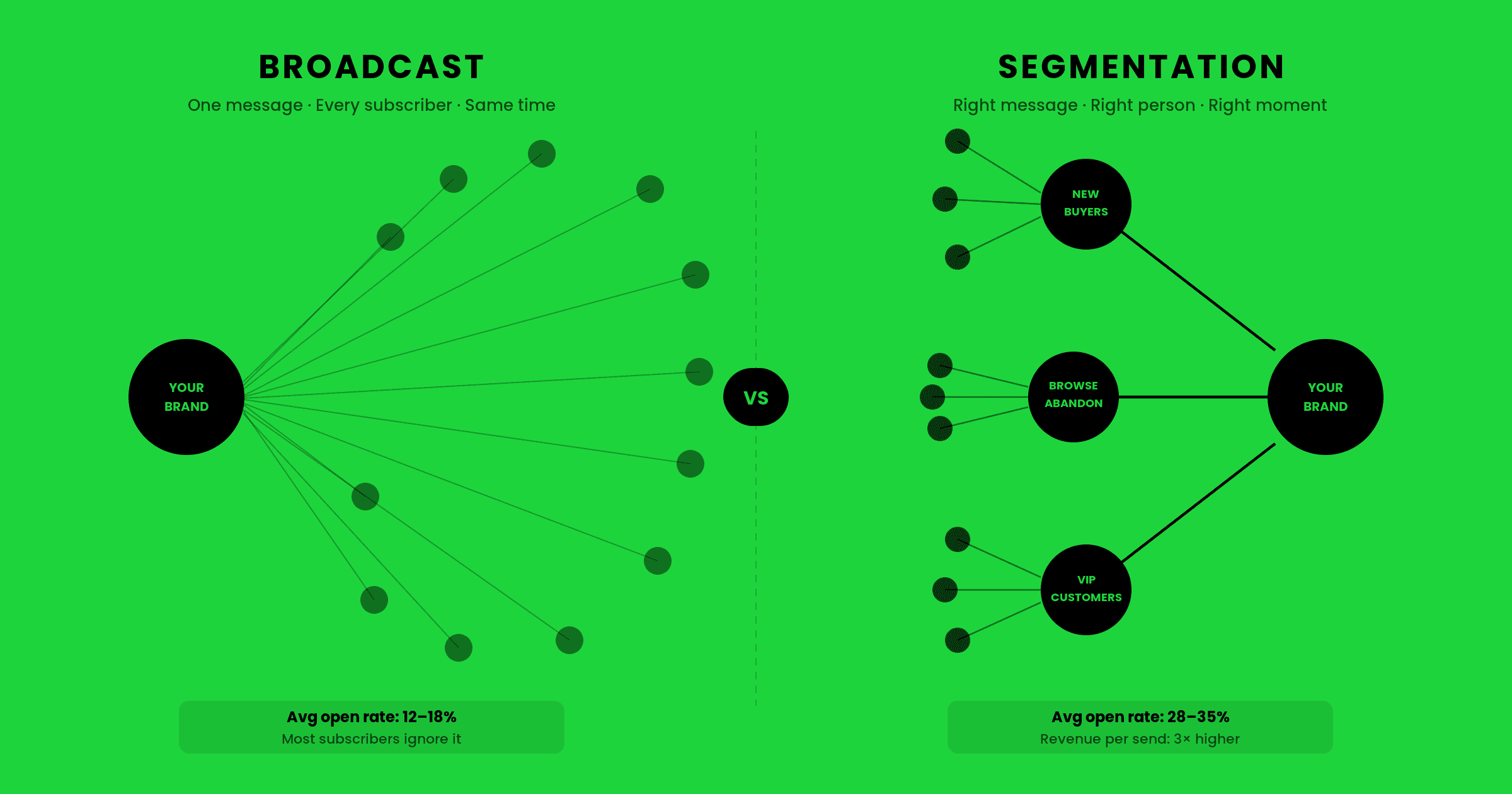
Segmentation underpins everything. Flows operate on segments. A flow architected against a segment definition that's two years stale is sending the right message to the wrong people. We rebuild segments before touching a single flow on every audit, see how we rebuild segments before touching a single flow for the segment-first methodology. The segment is the audience. The flow is the message. Get the audience wrong, the message can't recover.
The 2026-capable flow architecture stacks all three. Predictive triggers feeding into freshly-defined segments, with success measured on revenue per recipient and downstream order rate, not on opens. That's what the top-decile revenue numbers in the Klaviyo benchmarks reflect. Operators who rebuilt for the current capability set, not operators who tuned the 2019 architecture harder.
The five mistakes we see in 80% of accounts when we audit them.
Before the list, a word on how these show up. We've audited enough accounts on enough platforms to recognize the recurring failure pattern. These aren't edge cases. These are the default shape of an email program that was set up with the platform's wizard, handed off to a succession of marketing hires, and never rebuilt. Five mistakes show up in roughly four out of five accounts, regardless of platform.
One: the abandoned cart trigger fires on the wrong event. Default trigger is Started Checkout, or its equivalent on Mailchimp, ActiveCampaign, HubSpot, and Omnisend. The largest add-to-cart segment never reaches checkout. They get nothing. The fix is to trigger on Added to Cart and condition the flow path on whether they reached checkout. The same architectural mistake exists in every major platform. The trigger names differ. The outcome's identical.
Two: the welcome series is three emails when it should be seven to nine. Discount handoff, brand story, nudge, done. The brands earning the top-decile $21.18 welcome revenue-per-recipient number run seven to nine emails over 14 days, branching by source and quiz answer, progressively revealing product, founder story, social proof, and risk reversal. The default platform template is the floor, not the build.
Three: there's no win-back flow, or the win-back fires at the platform default. 180 days for everyone. Wrong for most stores. The right trigger is roughly 1.5 times the segment's average days between repurchases, computed from actual order data. The data lives in every platform. Almost nobody pulls it.
Four: post-purchase isn't sequenced. A single shipping confirmation, maybe a review request, no product-education email, no replenishment trigger, no cross-sell. Post-purchase is treated as transactional rather than as a retention asset. The reframe from the post-purchase section above applies. Measure on second-order rate, not on the placed-order rate of the message itself.
Five: deliverability is broken under the flows. No sunset flow. No domain authentication checks. No engagement-based segmentation suppressing inactive subscribers. Sender reputation degrades quietly. Inbox placement drops. Then everything looks "underperforming" and the team rebuilds copy when the actual problem is upstream. You can't out-flow bad deliverability.
Audit your flows against this list before you build a new one. The fixes pay back faster than any new build. They're the same fixes whether you're on Klaviyo, ActiveCampaign, HubSpot, Mailchimp, or Omnisend. The architecture's the same. The UI's the only thing that changes.
Where this leaves you. Flows produce 41% of email revenue from 5.3% of sends, and most businesses underbuild the welcome flow, the one with 8 times headroom between average and top-decile performance, while obsessing over the cart flow that has 2.3 times headroom. The architecture is the same on every platform. The leak is the same. The fix is the same. We run email marketing for any business on whatever platform you're already on, and we run the whole stack flat at $1,500/mo on whatever platform you're on. Your platform subscription is billed separately by the platform itself. Month-to-month. No tiers.
If you've got an email list, you're underusing flows, and you don't have time to fix it, we run email marketing for any business on whatever platform you're already on, $1,500 a month flat. Book a free 30-minute audit, and we'll tell you what we'd change in your flows before you decide anything.

Our mission is simple: help brands grow through better emails. We focus on strategy, design, and data to turn the inbox into a high-performing sales channel; without the noise. We believe great email marketing is clear, personal, and built to last.